
Francesco is a technical analyst at GPblog, specializing in the technical side of Formula 1. Through illustrations and analysis, he makes complex components and developments accessible to a wide audience.
Following this weekend’s Canadian Grand Prix, the FIA will publish the first list of manufacturers eligible for the new ADUO system, which allows struggling power-unit suppliers to develop their engines during the season.
ADUO stands for “Additional Development and Upgrade Opportunities” and is one of the key mechanisms introduced under Formula 1’s 2026 power-unit regulations. The system is designed to help manufacturers close the gap to the leading Internal Combustion Engine (ICE) without introducing a full Balance of Performance model.
The Canadian Grand Prix marks the end of the first monitoring period of the season, covering the opening five races from Melbourne to Montreal. Bahrain and Saudi Arabia were excluded following the cancellation of both events.
During each review period, the FIA evaluates the performance of every manufacturer’s ICE and calculates an “ICE Performance Index”, which determines whether a supplier qualifies for development concessions.
How will the system work?
ADVERTISEMENT
ADUO replaces the previous system, under which manufacturers could only update their power units between seasons.

Photo: Race Pictures
Under the new regulations, manufacturers that fall sufficiently behind the benchmark engine will be allowed to develop their homologated ICE during both the current and following seasons in an attempt to close the gap.
The FIA will monitor engine performance across three separate periods during the year before publishing updated rankings.
The performance index will consider several parameters, including engine speed and MGU-K contribution. However, variables such as aerodynamic influence and fluid temperatures will be excluded, as those are measured separately at car level.
ADVERTISEMENT
Importantly, ADUO applies only to the Internal Combustion Engine. The electrical components of the power unit are not included in the concession system.
Which periods will the FIA monitor the ICEs?
The 2026 F1 season has been divided into three monitoring periods, during which the FIA will calculate and check the Performance Index for every ICE on the grid and will draw up a ranking on which to base the concessions.
The first period is formed by the first five races of the season (from Melbourne to Montreal) and the results of the measurements will be published no later than two weeks after the Canadian Grand Prix.
The second period will occur from Monaco to Hungary, covering a total of six races, and the third period will cover the next six, from Zandvoort to Mexico. Teams will be allowed to bring upgrades and changes to their ICEs as early as the following race.
ADVERTISEMENT

Photo: Race pictures
The ADUO will be granted to those ICEs which are at least 2% behind the best-performing ICE.
The advantages the different constructors will be given depend on the lag:
- If a manufacturer’s performance index is at least 2% but less than 4% below the best-performing ICE, they are allowed to bring a homologation update for the current season and one update for the following season.
- If a manufacturer’s performance index is at least 4% below the best-performing ICE, they will be allowed to bring two additional upgrades in the current season and two more upgrades in the next season.
ADVERTISEMENT
An important aspect is that updates aren’t cumulative in a single season: this means that if a manufacturer that is eligible for ADUO within the 4% threshold doesn’t bring a homologation upgrade to their ICE in 2026, they can’t bring two homologation updates in 2027.
However, the updates will be usable if a manufacturer falls within the ADUO threshold for the following season as well.

Photo: Race Pictures
Example scenarios
If Aston Martin Honda were to finish more than 4% behind the benchmark ICE after the Canadian Grand Prix, it would receive permission to introduce two engine upgrades during 2026 and another two during 2027.
ADVERTISEMENT
If Honda then remained more than 4% behind after the first review period of 2027, it would again qualify for two further upgrades in both 2027 and 2028.
That would effectively allow Honda to introduce four ICE updates during the 2027 season: two earned from the 2026 assessment and two from the opening review period of 2027.
By contrast, if Ferrari qualified for only one upgrade in 2026 and failed to use it before the end of the season, that update allocation would expire. Ferrari would retain only the 2027 allowance.
Why ADUO is not F1's version of BoP
A very important aspect to take into consideration is that the ADUO isn’t the equivalent of BoP (balance of performance) in endurance racing: with ADUO manufacturers will be allowed to make changes to their ICEs to improve performance, but they’ll need to produce the best engine to effectively become the reference of the ADUO ranking.
ADVERTISEMENT
Moreover, this method doesn’t involve slowing the best ICE down to favour racing, but by simply giving more time and resources to teams to develop their own engine.
The FIA single seater Technical director Nikolas Tombazis explains the method as follows: “It’s important to make clear that ADUO is not a kind of balance of performance mechanism. A team or manufacturer will not suddenly get greater fuel flow rate or more or less ballast. It is, in fact, a Cost Cap relief mechanism, where a PU manufacturer meeting ADUO criteria during a review period is given an opportunity to develop its engine through a downward adjustment. That’s not to underestimate it but a manufacturer will still need to make the best engine in order to win.”
Having understood how the ADUO will work, the most interesting question now is: how will it impact performance among the top constructors? Everything will depend on the Performance Index calculated by the FIA.
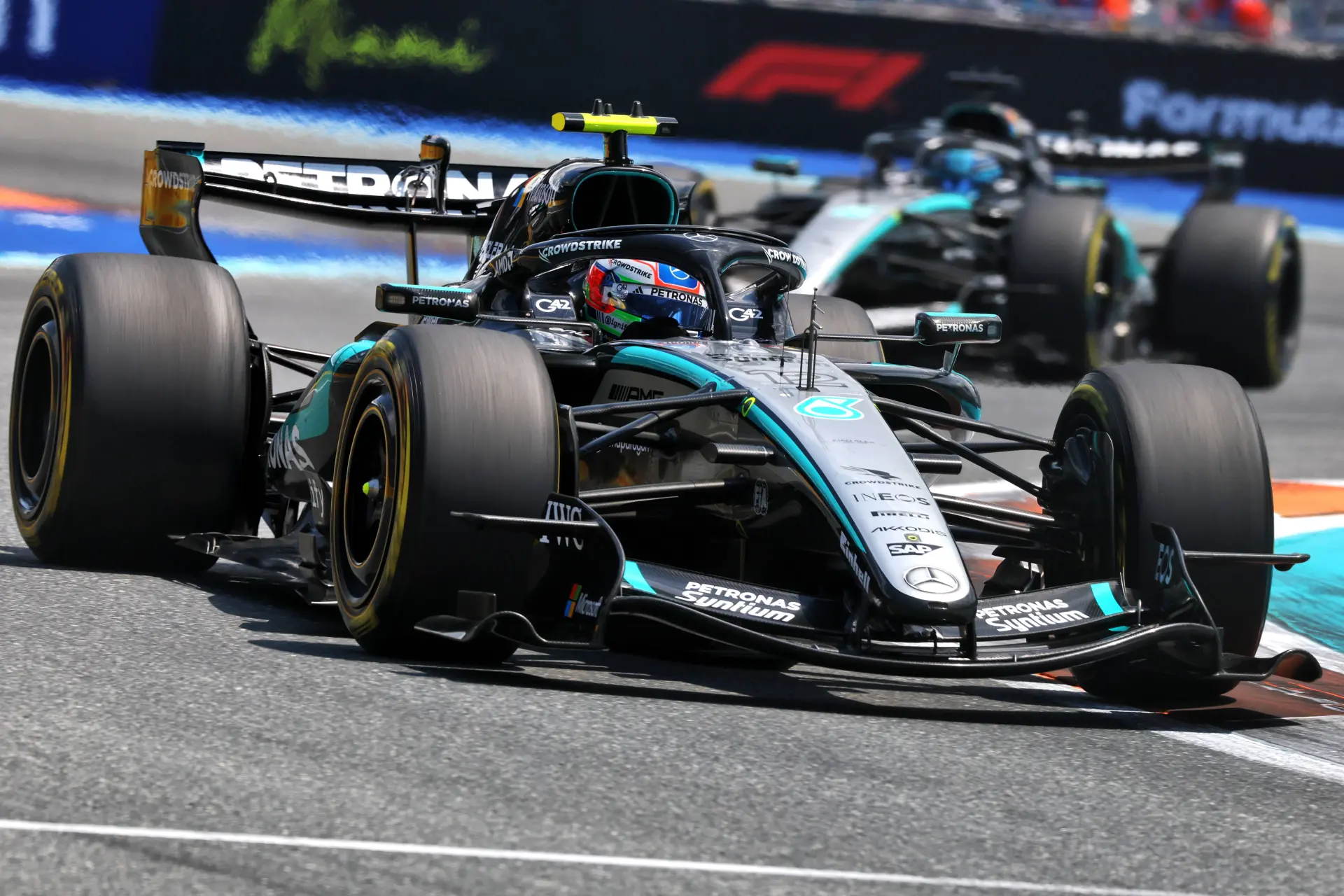
From what we’ve seen during the first four races, Mercedes seems to have the best ICE, which gives them a big advantage during the super-clipping phase and in qualifying, where they can use higher engine modes compared to Ferrari.
ADVERTISEMENT
However, the performance seen on track could also (and it certainly is) be influenced by the car's performance, which, however, will not be taken into consideration by the ADUO.
Therefore, since the FIA will evaluate exclusively the performance of the ICE, excluding the electrical component as well, it is extremely difficult for us to understand which team can actually have the best engine, precisely because it is very often “masked” by the performance of the aerodynamics, chassis, tyres, and the numerous other aspects that contribute to an F1 car.
Read also



ADUO Takeaway
Manufacturers become eligible for ADUO if their ICE performance index is at least 2% below the benchmark engine.
ADVERTISEMENT
Manufacturers between 2% and 4% behind
- One homologation update in the current season
- One homologation update in the following season
Manufacturers more than 4% behind
- Two homologation updates in the current season
- Two homologation updates in the following season
However, those upgrade allowances are not cumulative within a season.
Don’t miss GPblog in Google
Mark us as a preferred source and our articles will appear more often at the top of Top Stories.
Add as a preferred / source on GoogleRead more about:
latest news







Bahrain Grand Prix
Overview
... ...
Practice 1
...
Practice 2
...
... ...
Practice 3
...
Qualification
...
... ...
Race
...
... ...
Practice 1
...
Practice 2
...
... ...
Practice 3
...
Qualification
...
... ...
Race
...
Times are in your local timezone
Rumors
Popular on GPBlog

1
F1 driver set for Bahrain GP back-of-grid start after engine penalty
1561 times read

2
Bottas says F1 drivers don't want to finish season in Italy amid tax threat
1145 times read

3
Back-of-grid start confirmed as three drivers face Sepang setback
935 times read

4
‘You just have to pay it’: Verstappen responds to F1 drivers’ Italian tax concerns
847 times read
F1-stand 2026
Season
| Pos. | Driver | Team | Points |
|---|---|---|---|
1 | MercedesMER | 302 | |
2 | MercedesMER | 236 | |
3 | FerrariFER | 199 | |
4 | McLarenMCL | 186 | |
5 | FerrariFER | 179 | |
6 | Red Bull RacingRBR | 163 | |
7 | McLarenMCL | 120 | |
8 | Red Bull RacingRBR | 86 | |
9 | Racing BullsRCB | 59 | |
10 | AlpineALP | 41 |
Loading