F1 Tech | Audi fears problems at the start of their first race
Audi's vertical cooling inlet and sidepod design introduced in Bahrain - Image: Francesco Bianchi

Francesco is a technical analyst at GPblog, specializing in the technical side of Formula 1. Through illustrations and analysis, he makes complex components and developments accessible to a wide audience.
Audi showed some really interesting technical solutions in Bahrain, even if a car’s weakness could represent a big problem for the first race in Melbourne.
With less than a week until the first race in Melbourne, the Audi Revolut F1 Team is ready to make its debut in Formula 1 as a constructor, a huge milestone for the historic automotive brand and for the sport in general.
The Barcelona shakedown highlighted some weaknesses in the 2026 project, with the R26 able to complete only 243 laps in 3 days. These troubles were then quickly solved before the two testing sessions in Bahrain, where the team managed to complete around 700 laps in 6 days of running.
Beyond showing a good progress in terms of reliability, Audi introduced some of the smartest and most discussed technical solutions along the whole paddock, including the vertical cooling inlets (which recalled the ‘zero-pod’ concept from Mercedes in 2022) and a peculiar rear wing’s DRS system, which differed from all other top teams’ one.
However, both drivers faced massive issues during the starting procedure, with the car stalling after they released the clutch. Could this problem strongly influence their first race in Melbourne? Let’s try to find out.
ADVERTISEMENT
An aerodynamic package rich in clever technical solutions
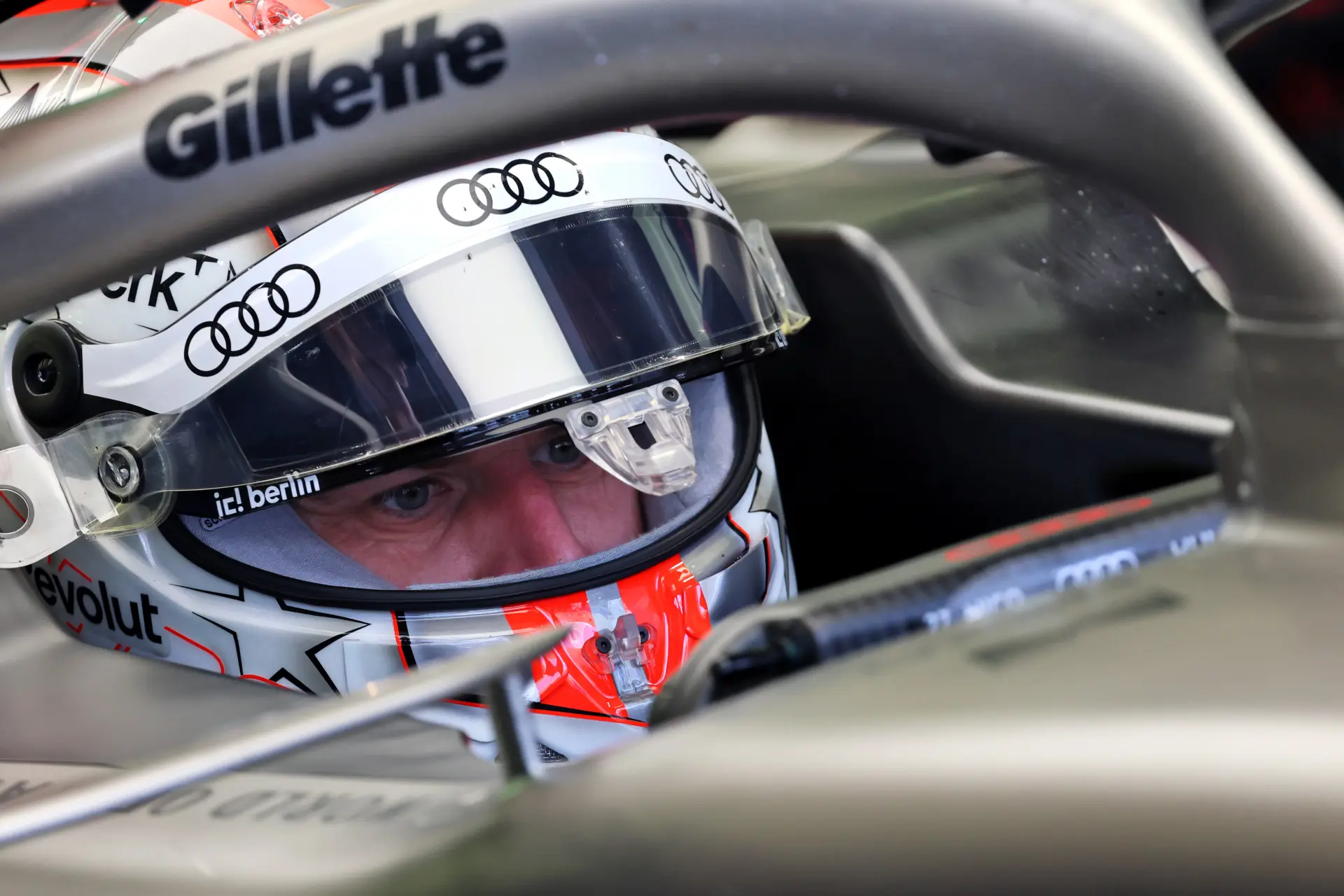
After three difficult days of testing in Barcelona, Audi’s engineers learnt from their mistakes and tried to improve the car’s performance for the following testing in Bahrain.
This included bringing a major package of upgrades that concerned all areas of the car, like the front wing, floor and the sidepod design, which left everyone speechless.
Starting with the front wing, the new version showed a lot of changes, both in terms of design and philosophy: as is visible in the drawing below, the new version features two DRS actuators, one for each side, as opposed to the previous solution, which featured a common actuator positioned under the nose (green arrow).
ADVERTISEMENT
This solution, shared only by the Racing Bulls, significantly increases drag but likely ensures correct and complete flap deflection, resulting in improved efficiency. Related to this choice, the new spec’s nose is lower and closer to the two flaps (yellow arrows): this design improves air suction under the nose, which is then pushed towards the T-tray and floor to increase the downforce generated.

Comparison between the front wing tested in Barcelona and the version adopted in Bahrain - Image: Francesco Bianchi
The new front wing also features a different design of the top two flaps: as highlighted by the blue arrow, the top flap has been completely redesigned, featuring a rounder shape and a greater chord in the central portion compared to the previous version.
The different flap design highlights a change in philosophy regarding the front wing: with the spec used during the Barcelona shakedown, the goal was to promote the in-wash effect, attempting to push air inwards from the front wheels, while the new version introduced in Bahrain is designed to push air outward from the front wheels, radically changing the flow directed towards the bodywork.
In this regard, the changes to the mainplane and endplate also align: the mainplane now features a more linear trend, while the previous version featured a curvature next to the endplate to generate a series of vortices and manage the turbulence produced by the contact patch (pink arrow).
ADVERTISEMENT
The new endplate, however, features a small vortex generator positioned at the end of the lower tray and curved outward to push the flows towards the outside of the front tyres, reducing drag (orange arrow).

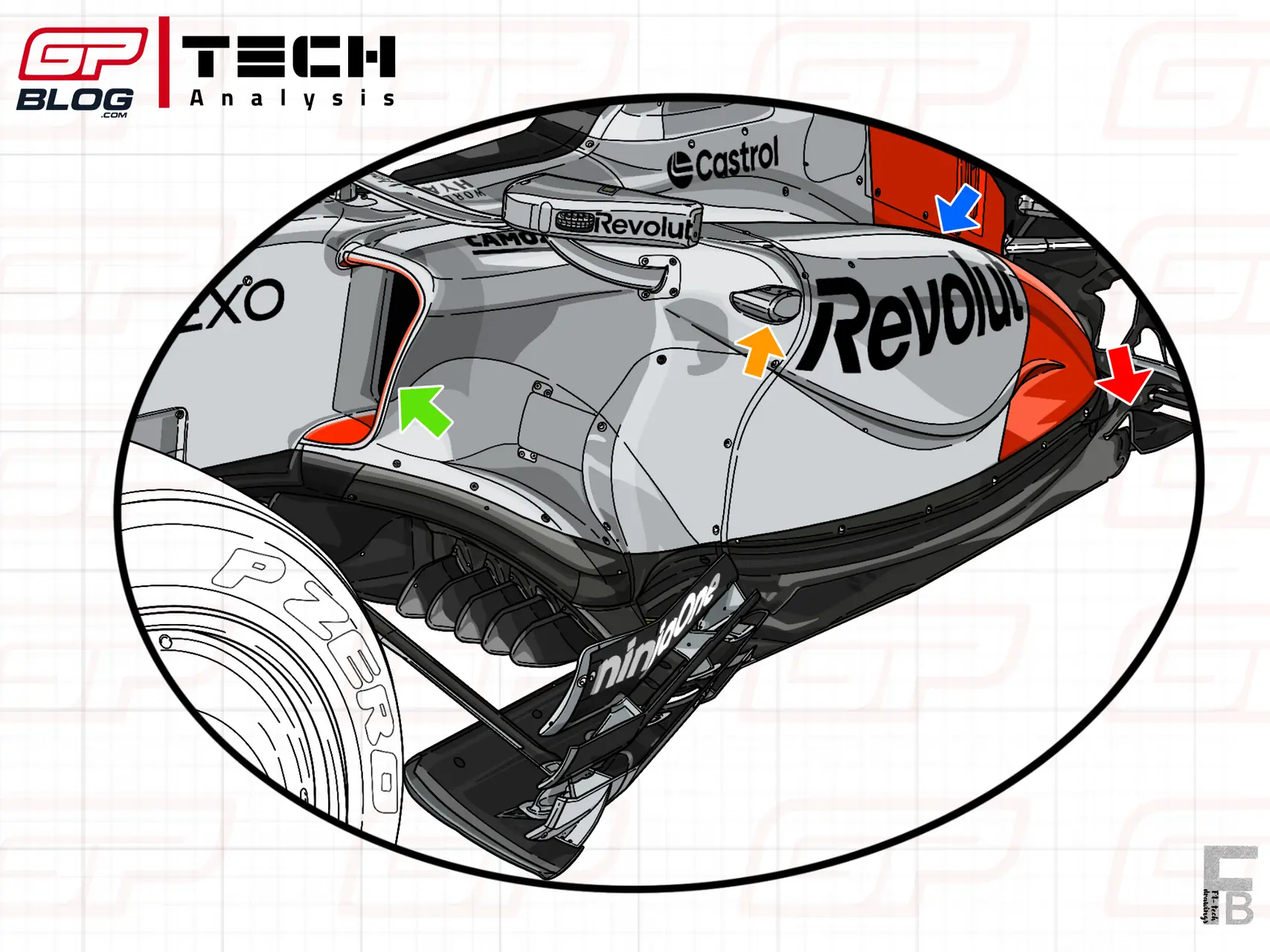
As for the sidepod design, Audi impressed all other teams, recalling some concepts seen at the beginning of 2022: the updated R26 featured vertical cooling inlets and a sculpted sidepod, which looked really complex and packed, proof of the great aerodynamic work done back at the factory.
As shown in the drawing below, in fact, the new sidepods feature a series of interesting technical solutions: starting from the vertical cooling inlet, it takes the shape of a flattened ear, with very small dimensions (green arrow).
This is an advantage in terms of aerodynamic efficiency, as the section exposed to the air is smaller. It also highlights the extensive work done to reduce the size of the cooling system design.
ADVERTISEMENT

Audi's vertical cooling inlet and sidepod design introduced in Bahrain - Image: Francesco Bianchi
The other major innovation is the shape of the sidepods: instead of adopting the 'zero-pod' concept as Mercedes did in 2022, the team's aerodynamicists decided to develop a sidepod concept that divides the air into two channels: an upper one, to direct air towards the rear of the floor and the diffuser (blue arrow), and a very small lower one, to push air towards the floor edge, thus also promoting the expulsion of front tire wake towards the outside.
In this regard, the packaging was so tight that the side impact structure (SIS) protruded, similar to what Red Bull did on the RB22. This serves an aerodynamic function by generating small vortices that prevent the flow of air from detaching along the side (orange arrow).
Last but not least, the changes to the floor are also visible from this view: as highlighted by the red arrow, the rear part of the floor now features two triangularly folded elements with a curved outer edge.
This creates a small channel in the lower part that aims to push the airflow towards the 'mouse hole,' while the shaped edge aims to push the turbulence produced by the rear tyres outwards.
ADVERTISEMENT
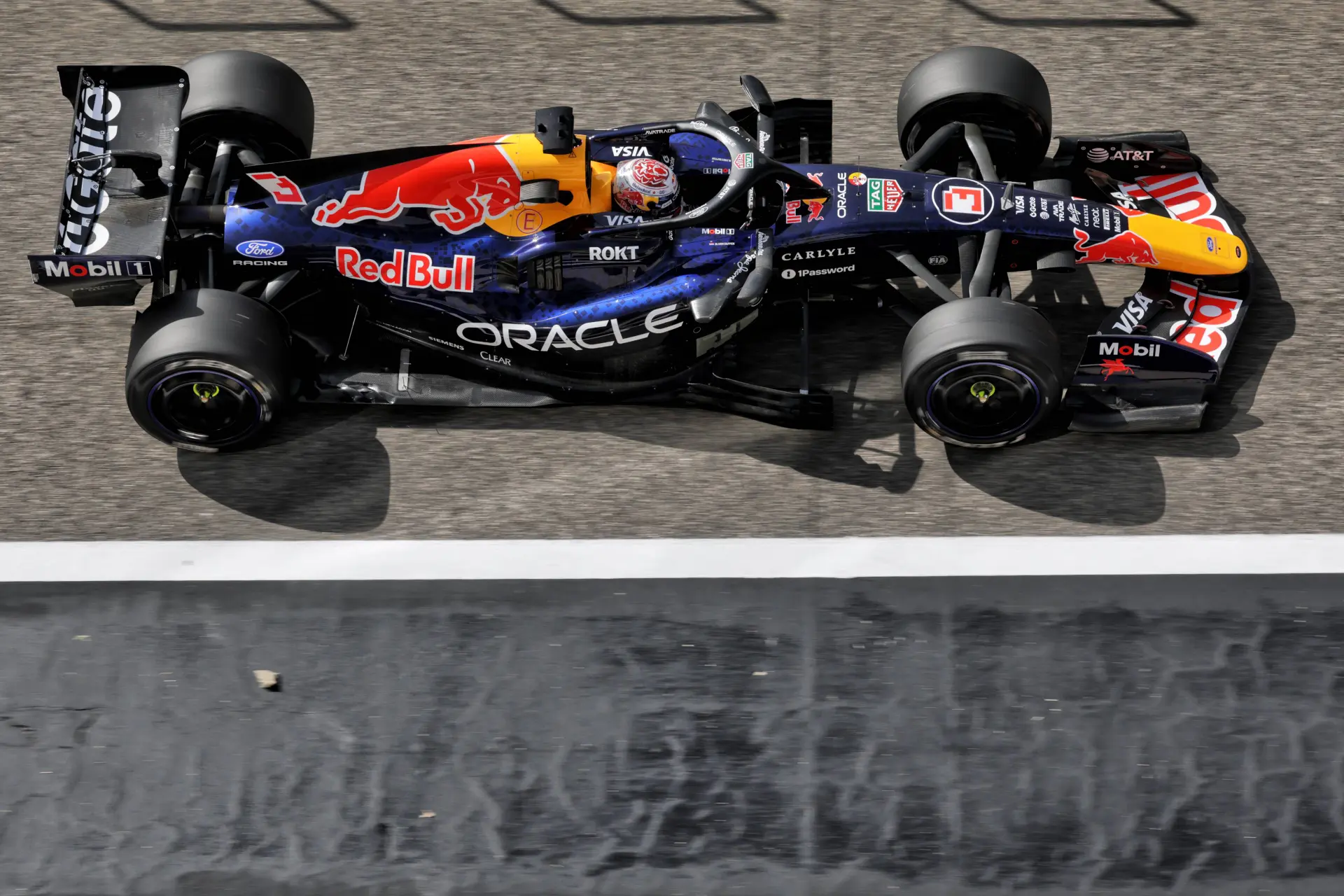
The last big innovation that characterised the R26 already since the Barcelona shakedown was the rear wing’s DRS system: as is visible in the image below, Audi’s engineers chose to position the pivot, around which the rear wing rotates, in the centre of the supports located on the endplate, causing the wing to open "in half" (the top flap is pushed backwards while the second one goes up).
This design, however, impressed for both the uniqueness and the detailed analysis of airflow around the rear wing done to come up with a similar solution.

Audi's rear wing DRS system on the straight - Image: Race pictures
When asked by media, including GPblog, about these bold technical choices, Team Principal Jonathan Wheatley described their approach as follows: “We put a car together early. So you define an aerodynamic package to run the car in an early state. And compared with this sophisticated package we have in the car now, it's quite crude.”
ADVERTISEMENT
“We ran. We were putting mileage on the car and not putting mileage on the car and learning all the time. And then I'm encouraged, you know, we have a hugely bold approach to these technical regulations,” said the former Red Bull Racing Sporting Director.

Why is Audi struggling with the starting procedure?
Beyond these technical innovations, however, the R26 still showed a big limitation compared to others: the starting procedure. During the second week of testing in Bahrain, it emerged that Audi’s drivers were massively struggling during practice starts; the car stalled as soon as the drivers released the clutch.
This problem is both related to the engine and to the new generation of cars: previously, the MGU-H kept the turbo "charged" electrically, but now, with the disappearance of the MGU-H, drivers are forced to maintain higher engine revs for a longer period of time to "charge" the turbo manually (for this reason, the FIA will grant an additional 5 seconds between the last driver on the grid and the lights coming on).
ADVERTISEMENT
In Bahrain, however, it was seen that Audi struggled greatly during the off-throttle phase, likely a sign of an incorrect setup and a need for more time to charge the turbo.
From this perspective, the team with the most advantage appears to be Ferrari, whose PU features a small turbine that can be fully charged very quickly, guaranteeing a significant advantage at the start.
In conclusion, Audi’s debut in Formula 1 has been really positive, as they demonstrated a positive and analytical attitude towards the new technical regulations. The team still has a long way ahead of them as a manufacturer, with many little issues yet to be solved and additional performance expected to be unblocked as their comprehension of all the systems improves. Beyond this, it’ll be extremely interesting to see where they’ll place on the grid in Melbourne, as the reliability and the consistency shown could be a big help in what promises to be a thrilling first race.
Read also


ADVERTISEMENT
Don’t miss GPblog in Google
Mark us as a preferred source and our articles will appear more often at the top of Top Stories.
Add as a preferred / source on Google