How the updated MCL40 challenged Mercedes in Miami
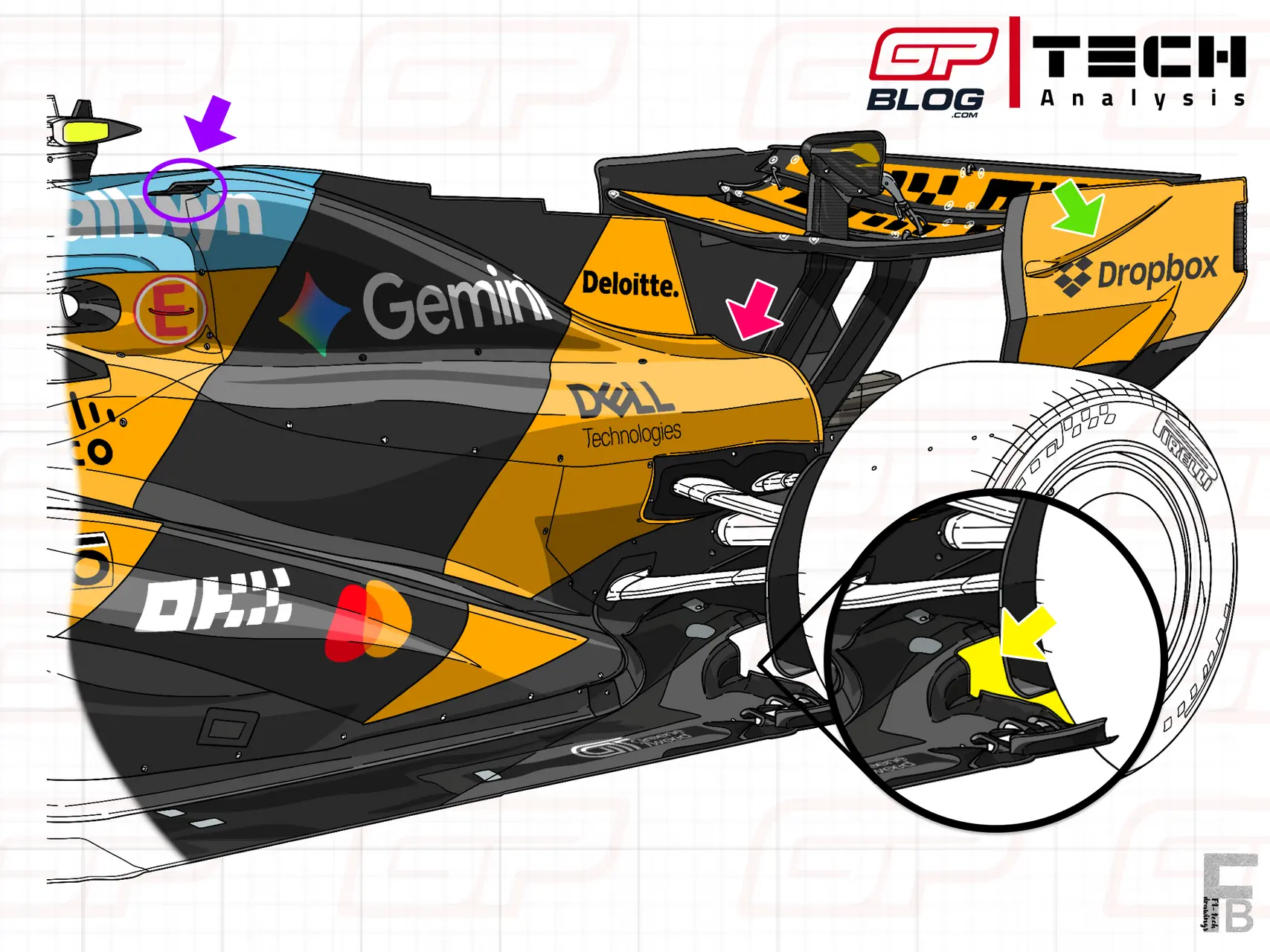
Photo: Francesco Bianchi
10:01, 12 May
0 Comments

Francesco is a technical analyst at GPblog, specializing in the technical side of Formula 1. Through illustrations and analysis, he makes complex components and developments accessible to a wide audience.
McLaren made a good step forward in Miami, thanks to a substantial package of updates, but also helped by the track conditions. Here is how the Woking-based team challenged Mercedes in the United States.
After a start to the season to forget, McLaren introduced a significant number of updates in Miami and managed to score the most points of all four top teams during the weekend, helped not only by the new components but also by the track conditions. The less-than-perfect execution from the team on the pit wall on Sunday denied Lando Norris his second victory in Florida, but the arrival of further updates over the next few races could make McLaren a genuine threat to Mercedes. Let’s try to understand why.
The two reasons behind McLaren's progress in Miami
With 48 points, a Sprint one-two finish and a double podium on Sunday, McLaren leaves Miami knowing that it has definitely made a big step forward compared to the first three races of the season, where the team managed to score just 46 points.
ADVERTISEMENT
The MCL40 seen in Florida looked like a totally different car compared to the one seen in Suzuka: much more balanced, easier to drive and, above all, much quicker.
This strong performance, however, was the result of a combination of two different factors:
- the large package of updates introduced by the team;
- the circuit layout and conditions.
Starting with the former, McLaren introduced a “B” version of the MCL40 in Miami, after running the base version that debuted during the Barcelona shakedown up until Suzuka. The new package included changes to the floor, rear wing, engine cover and exhaust exit.
Starting with the floor changes, a key modification can immediately be seen in the area ahead of the rear wheels. As highlighted in the drawing below, the new version introduced in Miami completely removed the diffuser sidewall and created a large “mouse hole” (yellow area and arrow), in line with the solutions adopted by Ferrari, Mercedes and Red Bull.
ADVERTISEMENT
The goal of this solution is to significantly increase the airflow towards the diffuser, increasing the amount of downforce produced. At the same time, this large opening works in synergy with the end portion of the floor ahead of the rear wheels, which features a raised lower edge acting as a “ramp”, directing the flow towards the “mouse hole”.

MCL40's updated floor and engine cover introduced in Miami - Photo: Francesco Bianchi
Regarding the changes to the engine cover, several small but extremely interesting solutions can be noted. The purple circle and arrow show a small winglet positioned in an area permitted by the regulations, intended to clean the turbulent wake generated by the air scoop and camera and direct it towards the rear wing. Furthermore, the engine cover has also been modified at the exit, with a wider and more curved profile (pink arrow), a solution suited to Miami’s hot climate, where larger cooling openings are required.
Last but not least, this view also allows us to appreciate a small profile added to the sides of the rear wing endplate (green arrow). This solution aims to generate a series of vortices, clean up turbulence from the rear wheels and improve the efficiency of the rear wing.
Regarding the changes to the front of the floor, the image below allows us to appreciate the new features of the external bargeboard. As highlighted by the pink arrow, the large triangular element now has a wavy profile and is much more pointed at the ends. Furthermore, the two “blades” positioned at the bottom are also more pointed at the exit, where they connect with a small vertical winglet that is part of this complex element.
ADVERTISEMENT

MCL40's changes to the bargeboard and mirror support introduced in Miami - Photo: GPblog
These modifications have two main objectives: first, to manage the front tyre wake by pushing turbulence outwards and preventing it from being sucked underneath the floor; and second, to generate a series of vortices capable of sealing the floor edge, maximising the downforce generated by the floor.
In this regard, although not visible in the photo, several vortex generators also appeared in Miami at the entrance to the floor. These vortex generators have a more rounded shape and are connected by a horizontal element, in line with a solution already adopted by Ferrari on the SF-26.
The image above also shows a different mirror support, highlighted by the blue arrow, with a simpler and more rounded shape compared to the more angular version used up to the Japanese Grand Prix. The team also introduced a very small flap underneath the exhaust exit to manage the hot air coming out of it, following a development path started by Ferrari with the FTM (Footbox Trailing Edge Modification).

McLaren's exhaust wing introduced in Miami - Photo: GPblog
ADVERTISEMENT
These updates immediately had a very positive impact on performance. From FP1 onwards, both Norris and Piastri appeared to have a much more balanced and calmer car underneath them while setting competitive lap times and, especially, delivering a very strong race pace simulation. This was proof that the team had also drastically improved its tyre management on high fuel, an area where it struggled during the opening races of the season.
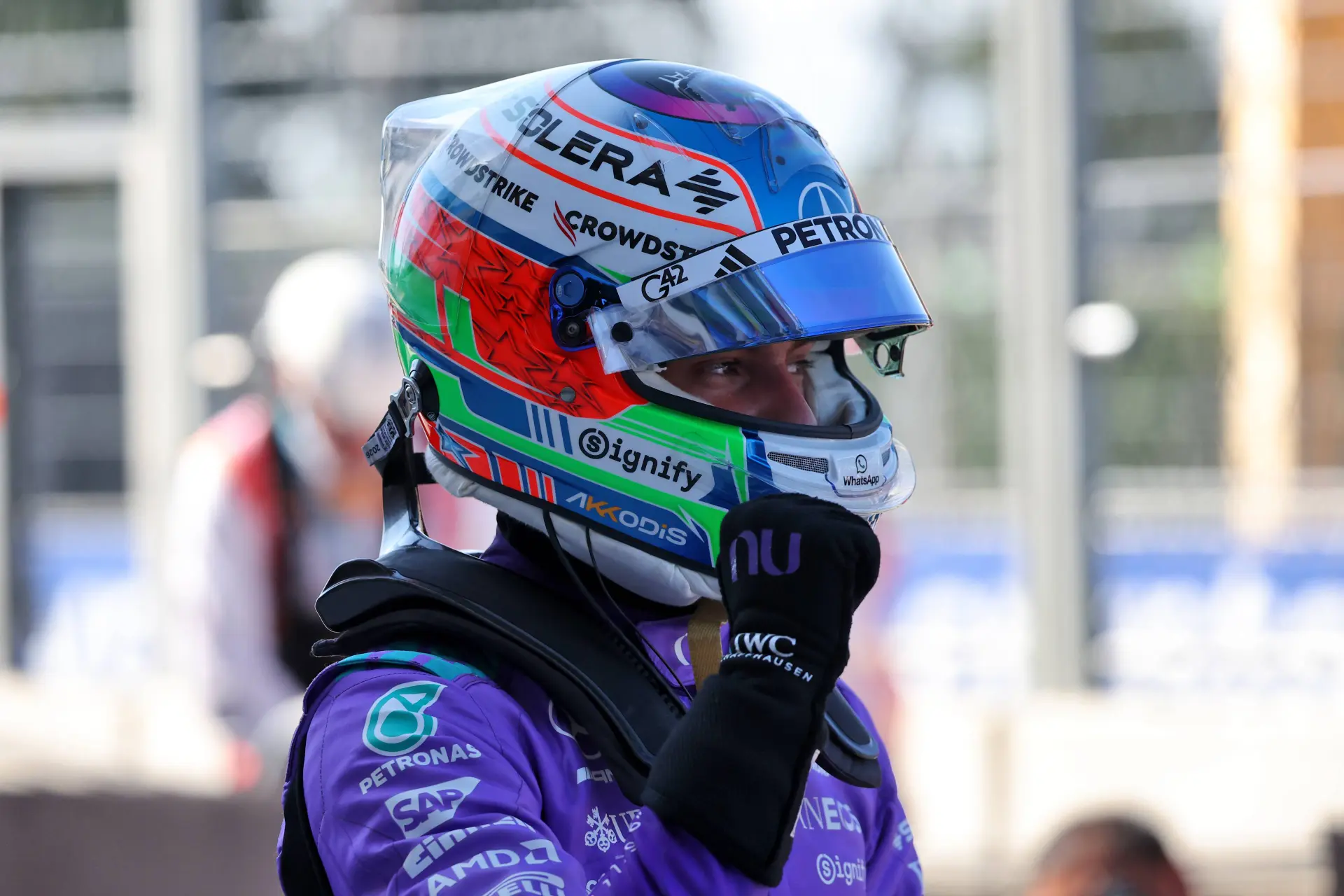
McLaren eventually secured a very strong one-two finish in the Sprint race, with Norris able to stay in front throughout and manage the pace, while Mercedes struggled to optimise its set-up up to that point. After working on the car between the Sprint and qualifying, Mercedes managed to secure both pole position and victory in the main race after a very tight battle with McLaren, especially on the hard tyres.
How the track layout and conditions allowed McLaren to rise
The great performance shown by McLaren, however, was also enhanced by the track conditions and layout. The Miami International Autodrome is a circuit that has traditionally suited McLaren thanks to its rear-limited characteristics and the low-grip, low-wear nature of the asphalt. These conditions appear to highlight the strengths of McLaren’s suspension and mechanical package, which performs at its best in this type of environment.
ADVERTISEMENT
As a consequence, the car came alive especially in the technical and slow-speed middle sector, where the MCL40 made a huge difference compared to its rivals, particularly on Friday, thanks to a softer suspension system that made the car easier to drive over the kerbs.

Norris and Piastri during the Sprint in Miami - Photo: Race Pictures
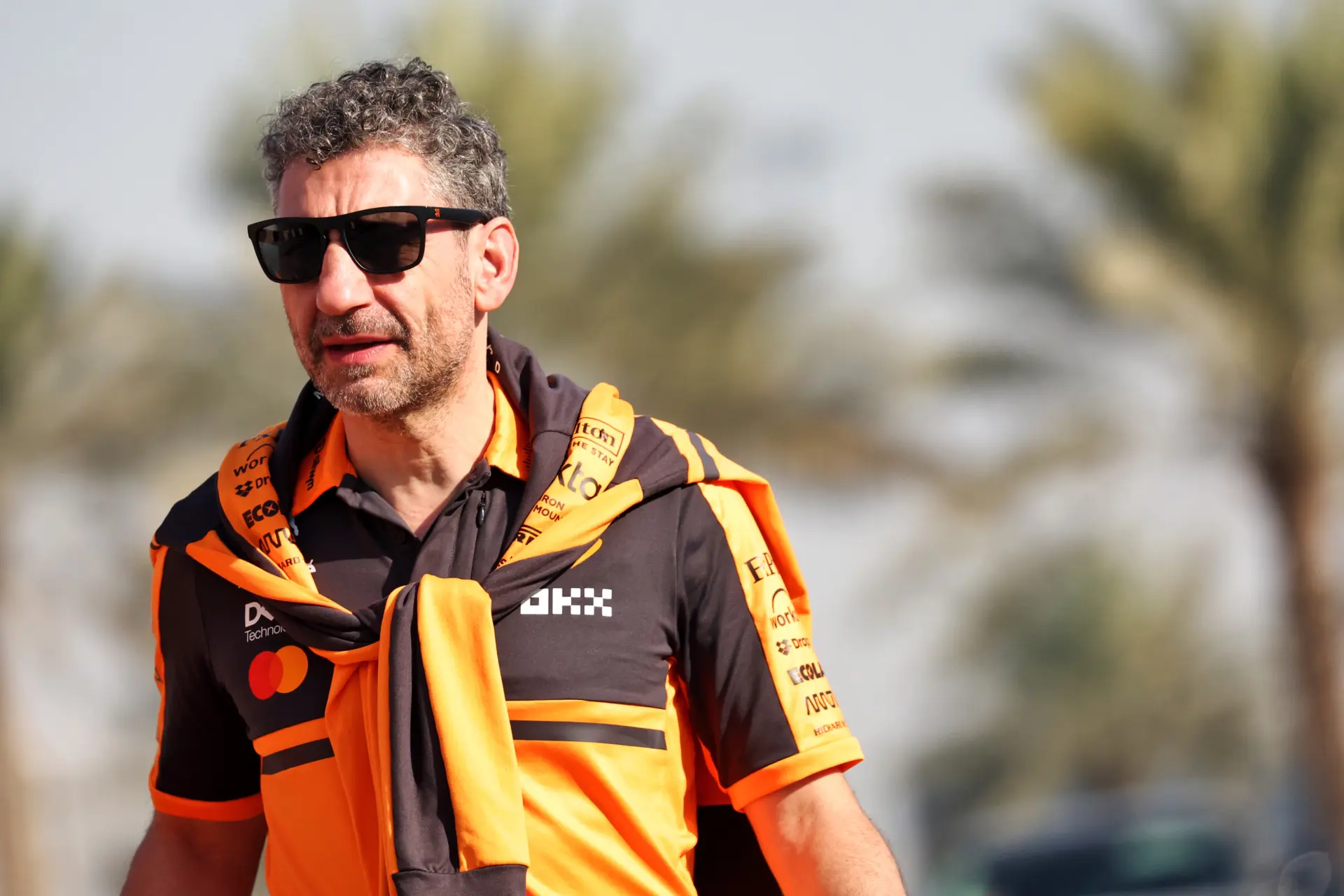
During his interview on Sunday evening, Team Principal Andrea Stella highlighted some very interesting concepts, explaining where McLaren’s advantage seems to come from at the moment: “I think they still possesses a couple of tenths of an advantage over everybody else. I think what we have seen is that, in the race, McLaren seemed to retain from last year the characteristic of being very consistent on the tyres, probably slightly more than some of our competitors. At the same time, I think the main advantage Mercedes has over us is pure pace, because their car is probably still a couple of tenths faster than ours.”
Explaining why the team was so strong in Miami, he concluded: “McLaren seems to have traditionally done very well in Miami, so it could be that the way we develop our cars suits this circuit. We’ll have to wait and see more. The corners where Mercedes is mainly faster than us are the high-speed corners. Then, in the race, if we look at the end of the first stint and the end of the last stint, Antonelli closed the gap in the first and extended it in the last.”
Read also
ADVERTISEMENT
Don’t miss GPblog in Google
Mark us as a preferred source and our articles will appear more often at the top of Top Stories.
Add as a preferred / source on GoogleRead more about:
latest news





Bahrain Grand Prix
Overview
Friday 02.10.26
Practice 1
04:30 AM
Practice 2
08:00 AM
Saturday 03.10.26
Practice 3
04:30 AM
Qualification
08:00 AM
Sunday 04.10.26
Race
07:00 AM
Friday 02.10.26
Practice 1
Fri 04:30 AM
Practice 2
Fri 08:00 AM
Saturday 03.10.26
Practice 3
Sat 04:30 AM
Qualification
Sat 08:00 AM
Sunday 04.10.26
Race
Sun 07:00 AM
Times are in your local timezone
Rumors
Popular on GPBlog

1
FIA reaches verdict on Hadjar as rival is hit with time penalty
1510 times read
2
F1 Standings | Antonelli recovers but Russell and Red Bull score big at Azerbaijan GP
1406 times read

3
Hadjar summoned after Baku GP as FIA calls up two more drivers
1247 times read

4
Hamilton's telling one-word response to Vasseur-Horner Ferrari rumours
1201 times read
F1-stand 2026
Season
| Pos. | Driver | Team | Points |
|---|---|---|---|
1 | MercedesMER | 302 | |
2 | MercedesMER | 236 | |
3 | FerrariFER | 199 | |
4 | McLarenMCL | 186 | |
5 | FerrariFER | 179 | |
6 | Red Bull RacingRBR | 163 | |
7 | McLarenMCL | 120 | |
8 | Red Bull RacingRBR | 86 | |
9 | Racing BullsRCB | 59 | |
10 | AlpineALP | 41 |
Loading