How Ferrari turned a feared weakness into victory at Silverstone
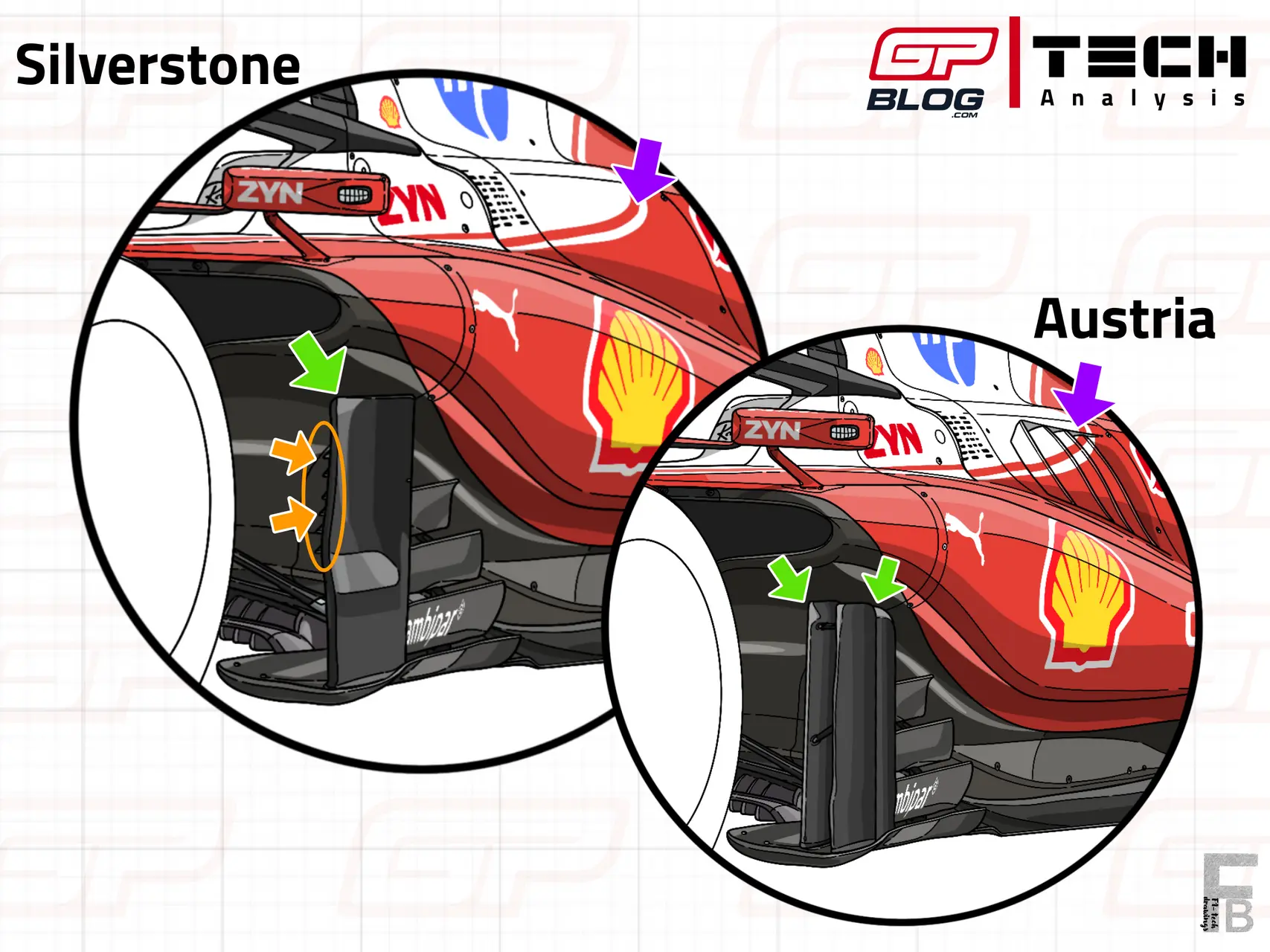
Ferrari's floor fence and cooling solutions used between Silverstone vs. Austria - Image: Bianchi Francesco

Francesco is a technical analyst at GPblog, specializing in the technical side of Formula 1. Through illustrations and analysis, he makes complex components and developments accessible to a wide audience.
Ferrari beat Mercedes at Silverstone thanks to an excellent set-up and highly effective energy deployment, although Kimi Antonelli's late-race issues ultimately paved the way for Charles Leclerc's victory.
The British Grand Prix weekend was a very encouraging one for Ferrari, as they managed to bounce back from a mediocre performance in Austria and fight against Mercedes during the entire weekend, eventually taking the victory as well.
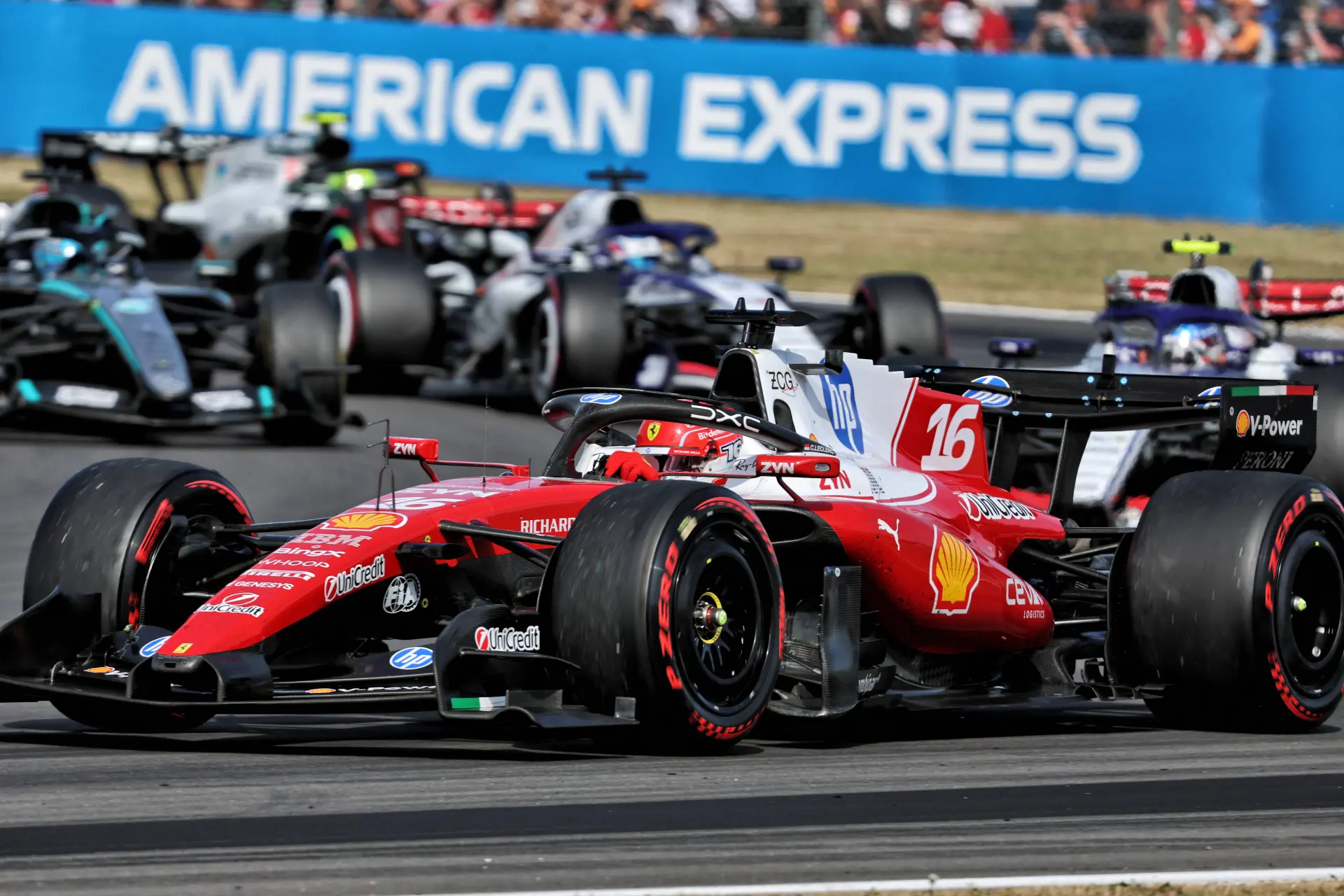
Leclerc’s win was also helped by Antonelli’s issues during his second stint, but up until that problem the Monegasque had done a very solid race, showing competitive pace and an optimal tyre management.
On Thursday both drivers expressed their concerns about the engine and on how that could be a limit around Silverstone, but the picture that emerged since FP1 was completely opposite. Let’s try to understand where this turnaround came from.
ADVERTISEMENT
The aerodynamic solutions that improved the SF-26
After a difficult weekend in Austria, the Scuderia’s hopes on the eve of the British Grand Prix were less than optimistic, because of their gap from the engine point of view, on a track that is extremely power sensitive.
However, in preparation for the weekend, the team back at the factory tested some specific solutions to reduce the SF-26’s drag and improve the car’s efficiency on the straights, a critical aspect for recharging the battery during the lap.
These solutions were also tested during FP1 in Austria on Hamilton’s car and included a simpler floor fence and a more closed engine cover to better suit the British cooler temperatures.
As highlighted in the drawing below, in the version tested in Austria and used since FP1 at Silverstone, the outer floor fence features a single vertical element (green arrow) with a twisted shape to push turbulence from the front wheels outward and reduce drag.
ADVERTISEMENT

Ferrari's floor fence and cooling solutions used between Silverstone vs. Austria - Image: Bianchi Francesco
In contrast, the version used in Austria and Barcelona featured three vertical elements with pointed, twisted ends to push turbulence from the front wheels outward. To improve turbulence management, micro vortex generators are also installed on the inner side to direct the flow outward (orange circle and arrow).
Furthermore, the engine cover used at Silverstone has no lateral vents to dissipate heat from the Power Unit, while the version used in Austria featured multiple grilles to dissipate heat (purple arrow).
These solutions were fitted on both cars from FP1 at Silverstone and, also thanks to the incredible preparation work done at Maranello during the previous few days, the SF-26 was very competitive out of the box.

Photo: Race Pictures
ADVERTISEMENT
Since the very first few laps on the hard tyre, in fact, the car showed a very good balance in the medium- and low-speed corners of the track and especially making a lot of difference on Mercedes in the third sector, proof of a different energy management strategy.
The team also kept this advantage during the Sprint qualifying on Friday afternoon, when especially Hamilton appeared to have full trust in the car and got pole on Antonelli by just 11 milliseconds, once again thanks to an optimal speed and energy management in the third sector of the track.
However, the Sprint lap times on the medium tyre proved that Mercedes still had an advantage over the Maranello based team. Even if Hamilton held the lead for the first eight laps, Antonelli then overtook him and pulled beyond the overtaking range, thanks to a faster pace.
The championship leader even set the fastest lap time of the Sprint on the last lap, a clear demonstration that Mercedes better treated the tyres on high fuel loads than Ferrari, and also had a much more balanced car, while Hamilton and Leclerc suffered from understeering.

Photo: Race Pictures
ADVERTISEMENT
After some major changes in the set-up, especially on Leclerc’s side of the garage, between the Sprint and qualifying, Ferrari’s engineers tried to sort out those small issues that caused an excessive front tyre degradation against Mercedes during the Sprint.
As a consequence, not only Leclerc regained his confidence during qualifying and qualified second, but also Hamilton finished the session in P3, showing that the SF-26 was still very strong over the single lap even if the adjustments aimed at improving the car for the Sunday race.
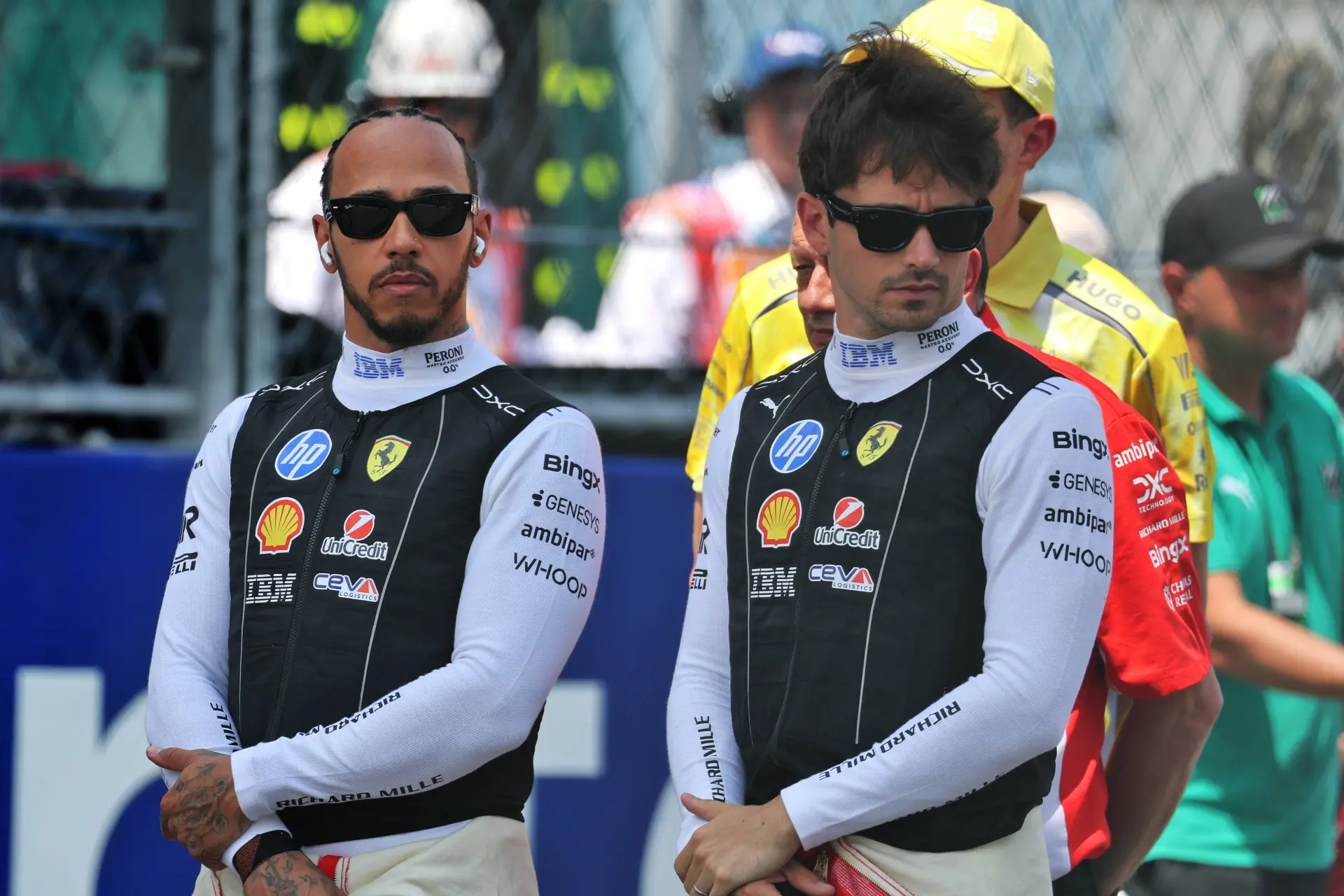
Why Ferrari leaves Silverstone with genuine optimism
Then, it was right at the start of the race that the real magic happened: despite a very similar reaction time between the first three drivers, Hamilton and Leclerc deployed slightly more electrical energy in the second phase of the start, managing to overtake Antonelli thanks to the big speed delta.
ADVERTISEMENT
From that moment onwards it was a constant battle lap to lap between the Mercedes driver and Leclerc in P1, as they had a very similar pace during the first stint on the medium tyres.
Mercedes opted to extend Antonelli's first stint on the mediums to give him a fresher final set of tyres with which to attack Leclerc. However, shortly after switching to the hard compound, Antonelli suffered damage to the front wheel shield, forcing an additional pit stop that effectively ended his race.

Photo: Race Pictures
Without Antonelli's technical issue, Ferrari would have faced a much tougher fight for victory, given Mercedes' apparent pace advantage during the closing stages. The SF-26 still suffers a bit compared to Mercedes on the straights and in high speed corners, but the great step forward made also in terms of energy management this weekend is a promising sign for the upcoming race in Spa-Francorchamps as well.
Read also

ADVERTISEMENT
Don’t miss GPblog in Google
Mark us as a preferred source and our articles will appear more often at the top of Top Stories.
Add as a preferred / source on Google