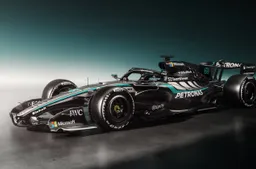
F1 Tech | The new Mercedes W17 is a heap of brilliant solutions
Lateral view of the new Mercedes W17- Image: AMG Mercedes Formula 1 Team
15:01, 26 Jan
1 Comments

Francesco is a technical analyst at GPblog, specializing in the technical side of Formula 1. Through illustrations and analysis, he makes complex components and developments accessible to a wide audience.
Mercedes completed the first laps with the new W17 at Silverstone, which looked aggressive and innovative.
After months of speculation and gossip about the new Mercedes engine, the Brackley team eventually unveiled its new W17 on Thursday and hit the track at Silverstone soon after.
Beyond the look and the technical details that emerged from the ‘real car’ (which looked very different from the renders shared online), the impressive thing is that the newborn car ran 200 km straight away without issues, while other teams like Audi and Cadillac couldn't take advantage of the whole distance allowed by the regulations.
Switching attention back to the technical aspects that emerged from the pictures, the new W17 shows some very clever and aggressive solutions on the aerodynamic side, including very sculpted side pods and some innovations on the floor and diffuser ramp.
With updates coming soon (ideally already at the first test in Bahrain), these concepts will be replaced by fresh ideas that will drastically improve performance. But until then, let’s try to explore all the elements of the new W17.
ADVERTISEMENT
Read also

Innovative front wing and front brake duct
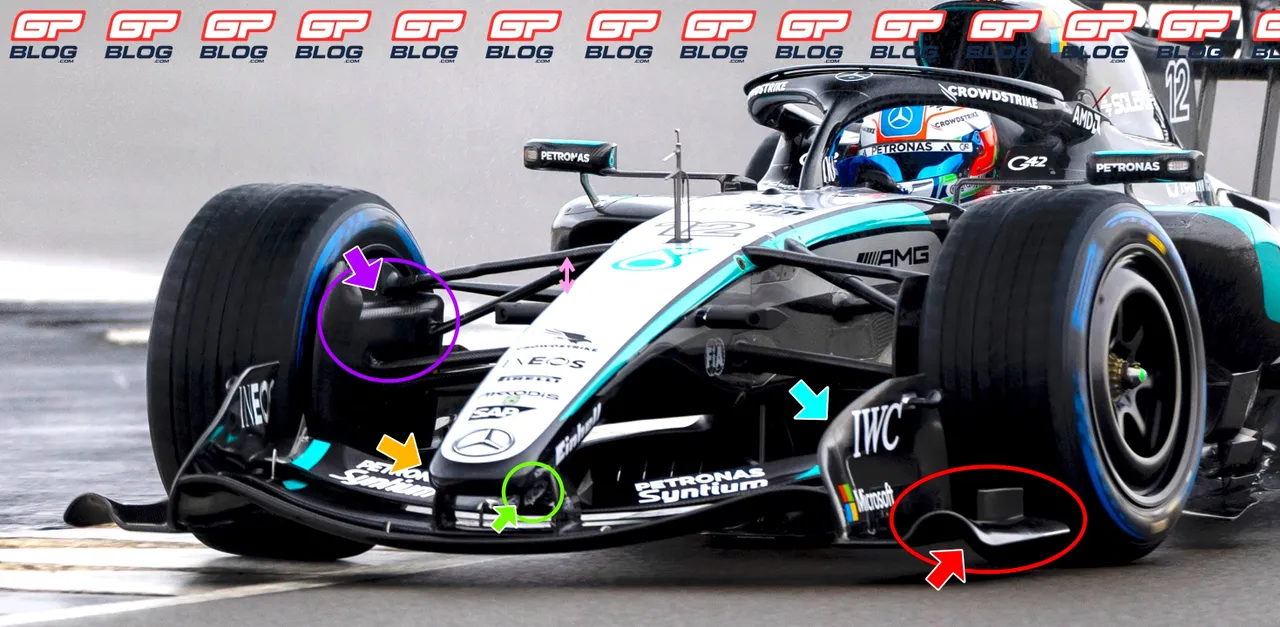
When analysing the front wing, the new W17 shows a very interesting design: as highlighted by the orange arrow in the image below, the nose is flattened and narrow at its most forward part, and, unlike the SF-26, the nose support pylons rest on the second flap of the front wing, not on the mainplane.
Furthermore, the green circle and arrow show that the DRS actuator is placed under the nose to achieve an efficiency advantage, both in terms of cable connections and in terms of drag and turbulence produced by the actuator.
Also, regarding the front wing, the endplate is not flat but has a marked curvature to promote out-washing, pushing air away from the front wheel and reducing the drag produced.
ADVERTISEMENT
In this regard, the endplate's sidewall is also very elaborate: as the red circle and arrow show, in fact, the front part of the tray has a shell shape and is facing upwards, trying to capture as much air as possible, create a vortex, and push it towards the outside of the front wheel.
Frontal view of the new W17 running at Silverstone - Image: Mercedes AMG Formula 1 Team
The winglet positioned above this duct has the same purpose. Having a look at the front suspension scheme, an eye-catching detail is how Mercedes’ engineers carefully structured and designed the front brake duct: as highlighted by the purple arrow and circle, in fact, the front brake duct is quite thick and directed to push the hot air of the brakes towards the outside, just behind the front wheels.
This design has a specific goal: hot air equals high pressure. By pushing it just behind the front wheel, it also channels the front tyre wake to the outside, preventing it from being sucked under the floor.
The last detail that emerges from this view is the anti-dive angle between the front and rear arms of the upper triangle on the front suspension: as highlighted by the pink arrow, the engineers adopted a very aggressive height distance between the two arms of the triangle, mainly to have an advantage under braking.
ADVERTISEMENT

With these new cars, having a stable platform under braking also favours the closure of the DRS on the front wing, beyond giving the driver a much more stable car. As seen on the MCL39 last year, however, this design could also give some trouble to the drivers: since the nose doesn’t sink under braking, they may not feel confident in terms of the grip provided, as happened to Lando Norris in the first half of 2025.
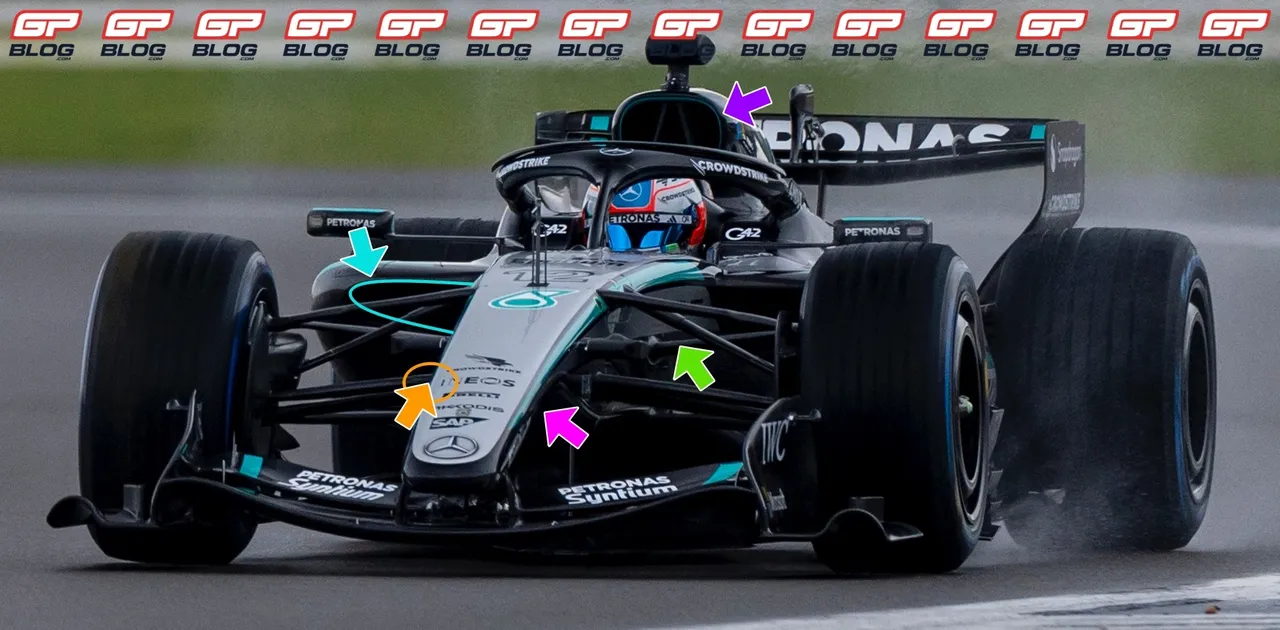
Moving now on to analyse a very similar view, it’s possible to appreciate a few more details on the front end of the W17: as shown by the pink arrow, the nose of the car is hollowed out in its lower portion, as it was with the ground-effect cars.
Moreover, the orange arrow and circle show how the front arm of the lower triangle and the steering rack are inclined upwards and connect to the chassis in a much higher position compared to where they connect to the wheel hub.
This design clearly favours aerodynamics, as the air that follows the edges of the nose of the car is then pushed towards the floor inlet by these two elements, which act like winglets. Having a look at the light blue line and arrow, the cooling inlet now has more of an oval-triangular shape, with the shark mouth design seen until 2025.
ADVERTISEMENT
A different angle to appreciate the new Mercedes W17 - Image: Mercedes AMG Formula 1 Team
The goal is to generate a high-pressure area in front of the cooling inlet, to maximise the air sucked into the engine and to also keep away the front tyre turbulence.
Last but not least, the purple arrow points at the air scope, which has an oval design with two lateral ears, very similar to the one used until the end of last season. This suggests that Mercedes engineers decided to place radiator masses behind the driver, thus requiring more air for cooling.
Short sidepods and an elaborated floor fence
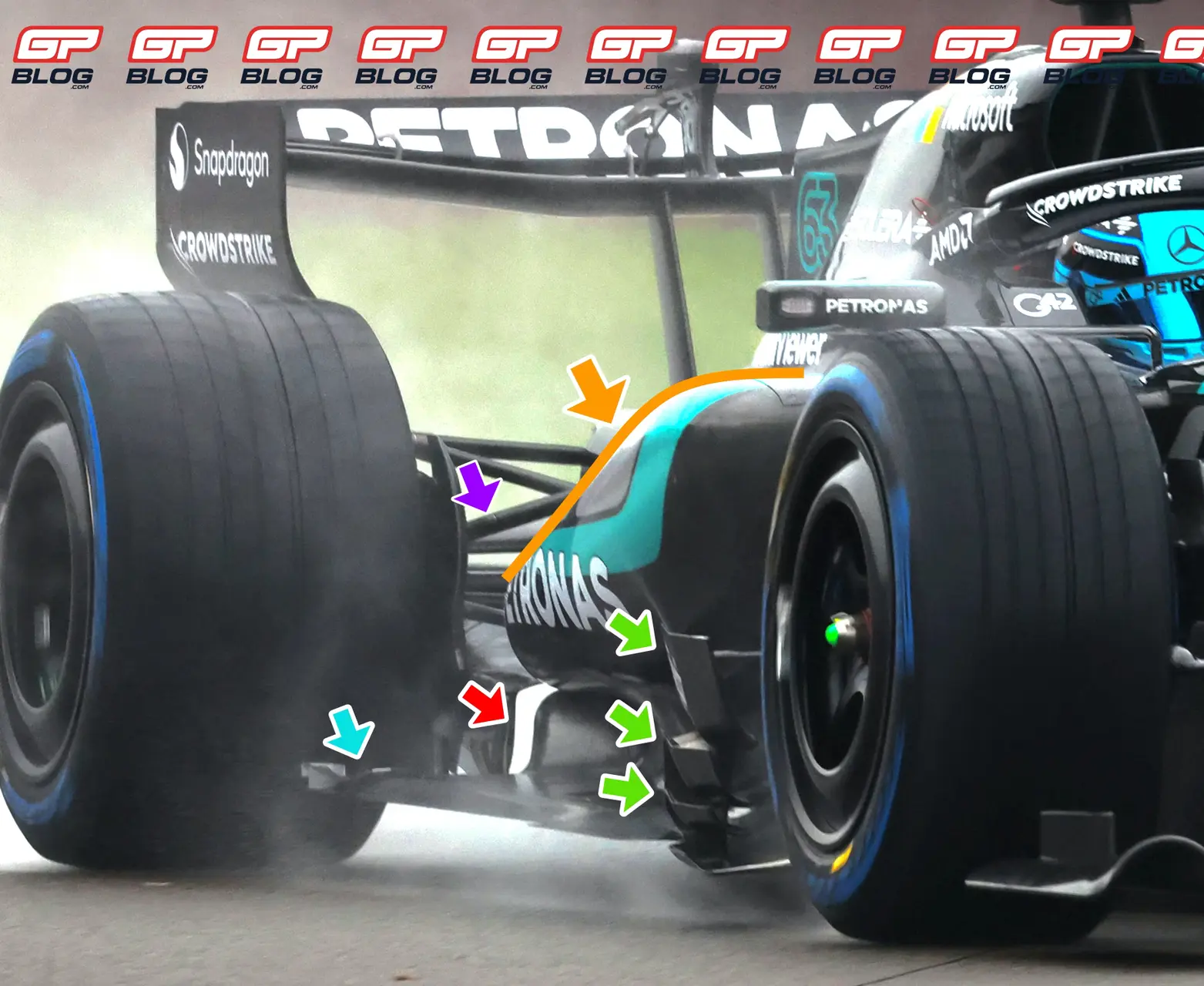
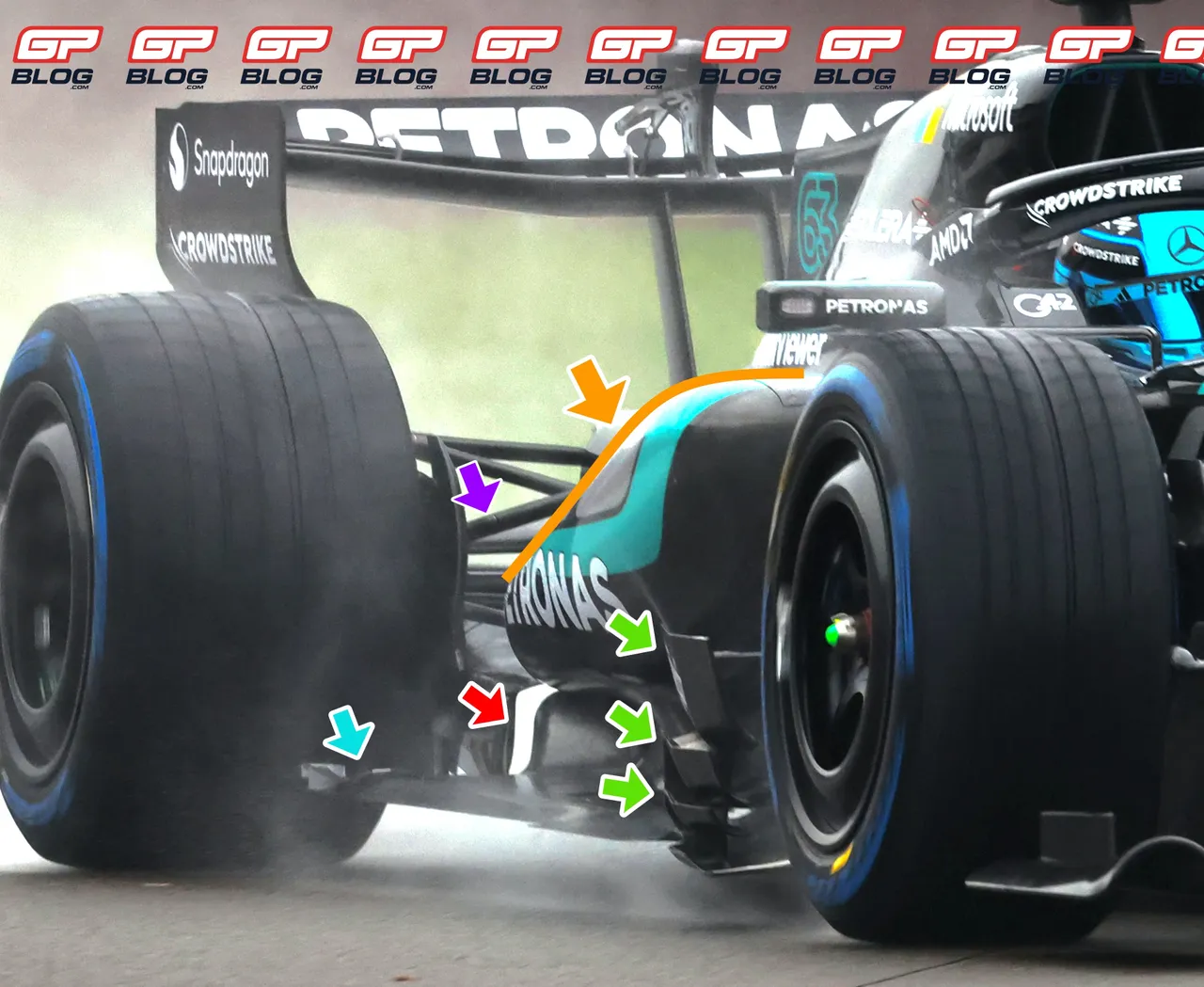
Moving now on to the lateral view, it’s possible to appreciate a lot of interesting solutions both on the sidepod design and on the floor itself: starting from the frontal portion of the floor, the green arrows point at the floor fence located behind the front wheels.
ADVERTISEMENT
As is visible, Mercedes engineers decided to divide this bulkhead into three horizontal elements, which were also carefully designed and angled to best manage front wake turbulence. The upper horizontal element is longer than the other two and has a curved shape to push air towards the lower part of the bodywork.
The other two elements below have a similar shape to the one just described, but have a greater angle of attack, proof that their main goal is to push the turbulence towards the outside.
Interestingly, the lowest layer of this structure also has its outer edge curved upward, generating a series of vortices that seal the underbody, maximising the downforce generated beneath the car and preventing gusts of air from damaging the airflow.
Lateral view of the new Mercedes W17- Image: Mercedes AMG Formula 1 Team
In front of the rear tyres, as highlighted by the light blue arrow, there are 45° cuts in the final part of the floor, above which metal vortex generators are positioned. The purpose of these components is to generate vortices that can keep tyre squirt away from the underbody and the diffuser, preventing it from being sucked into the diffuser and damaging the airflow.
ADVERTISEMENT
To this end, Mercedes’ aerodynamicists have also created a big visible "mouse hole" on the diffuser ramp, precisely to increase the airflow and generate a greater level of downforce (red arrow).
The last two details that emerge from this view are the shape of the sidepods and the rear suspension layout adopted: as highlighted by the arrow and the orange line, in fact, the sidepods are very short and have a sloping shape to maximise the Coanda effect (i.e., the tendency of a fluid to follow the nearby surface), pushing as much air as possible towards the rear end of the car.
Finally, the purple arrow shows that the engineers, in line with Ferrari and Red Bull, have decided to adopt the push-rod scheme also at the rear suspension, a convenient solution from both a mechanical and aerodynamic point of view.
In conclusion, the new Mercedes W17 showed off a lot of interesting solutions and details during its shakedown at Silverstone, proof of the great work done by the whole team during the winter.
The goal is to try to fight for the Championship after 4 years away from the spotlight. If the engine rumours are true, Mercedes has all the cards to be the favourite in 2026, but it’ll be interesting to also understand how their client team, McLaren, will stand between the Brackley team and the Championship.
ADVERTISEMENT
Read also

Don’t miss GPblog in Google
Mark us as a preferred source and our articles will appear more often at the top of Top Stories.
Add as a preferred / source on GoogleRead more about:
latest news





Spanish Grand Prix
Overview
Friday 11.09.26
Practice 1
11:30 AM
Practice 2
03:00 PM
Saturday 12.09.26
Practice 3
10:30 AM
Qualification
02:00 PM
Sunday 13.09.26
Race
01:00 PM
Friday 11.09.26
Practice 1
Fri 11:30 AM
Practice 2
Fri 03:00 PM
Saturday 12.09.26
Practice 3
Sat 10:30 AM
Qualification
Sat 02:00 PM
Sunday 13.09.26
Race
Sun 01:00 PM
Times are in your local timezone
Rumors
Popular on GPBlog

1
Russell summoned by the stewards as Norris receives Spanish GP fine
4658 times read

2
Ferrari confirms Hamilton’s Madrid qualifying fate after FP3 crash
4101 times read

3
Hamilton crashes and ignores race control, but isn’t penalized: here’s why
3854 times read

4
Stewards share verdict on Antonelli after post-qualifying investigation
3757 times read
F1-stand 2026
Season
| Pos. | Driver | Team | Points |
|---|---|---|---|
1 | MercedesMER | 267 | |
2 | MercedesMER | 201 | |
3 | FerrariFER | 191 | |
4 | McLarenMCL | 171 | |
5 | FerrariFER | 155 | |
6 | Red Bull RacingRBR | 127 | |
7 | McLarenMCL | 116 | |
8 | Red Bull RacingRBR | 71 | |
9 | Racing BullsRCB | 51 | |
10 | AlpineALP | 41 |
Loading