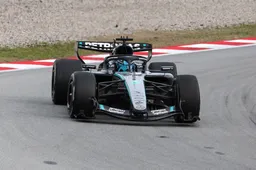
F1 Tech | Red Bull followed their own path with the RB22
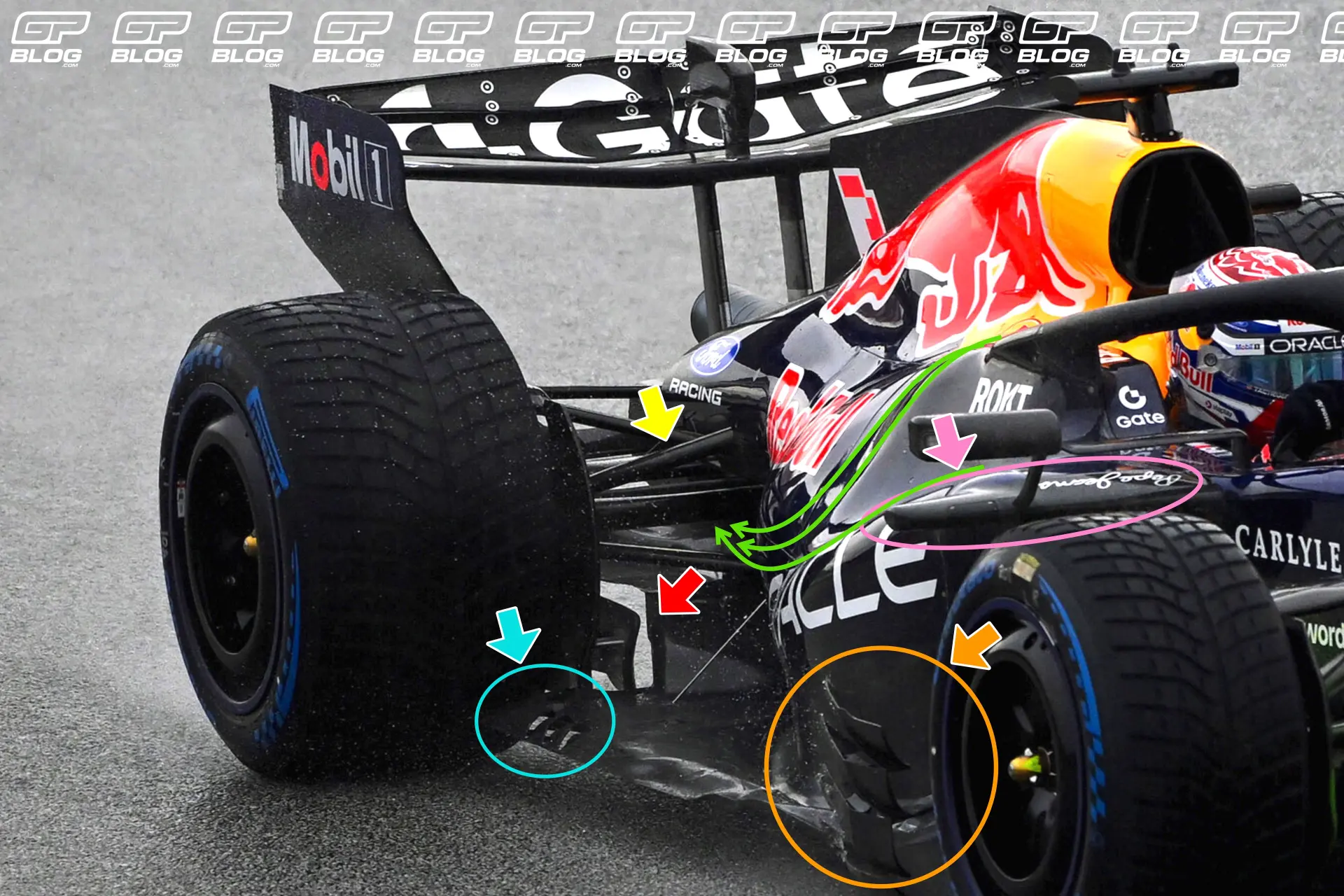
Lateral view of the RB22 sidepods - Image: Red Bull Content Pool
Updated: 11:39, 01 Feb
2 Comments

Francesco is a technical analyst at GPblog, specializing in the technical side of Formula 1. Through illustrations and analysis, he makes complex components and developments accessible to a wide audience.
Red Bull ran the ‘real’ RB22 during the Barcelona shakedown, and the new car showed some unconventional approaches, very different from the solutions adopted by other top teams.
After showing a first ‘simple’ edition of their new car at the launch in Detroit on the 15th of January, Red Bull hit the track in Barcelona with the real RB22, completing 187 laps in two days of running, with an additional 69 laps completed by Verstappen on Friday morning, proving the solidity and the reliability of the new Ford power unit.
The new car featured a series of interesting solutions, especially in the sidepod area and in the front suspension design. While the real performance of the RB22 is yet to be seen, let’s explore the design features that set it apart from other top teams.
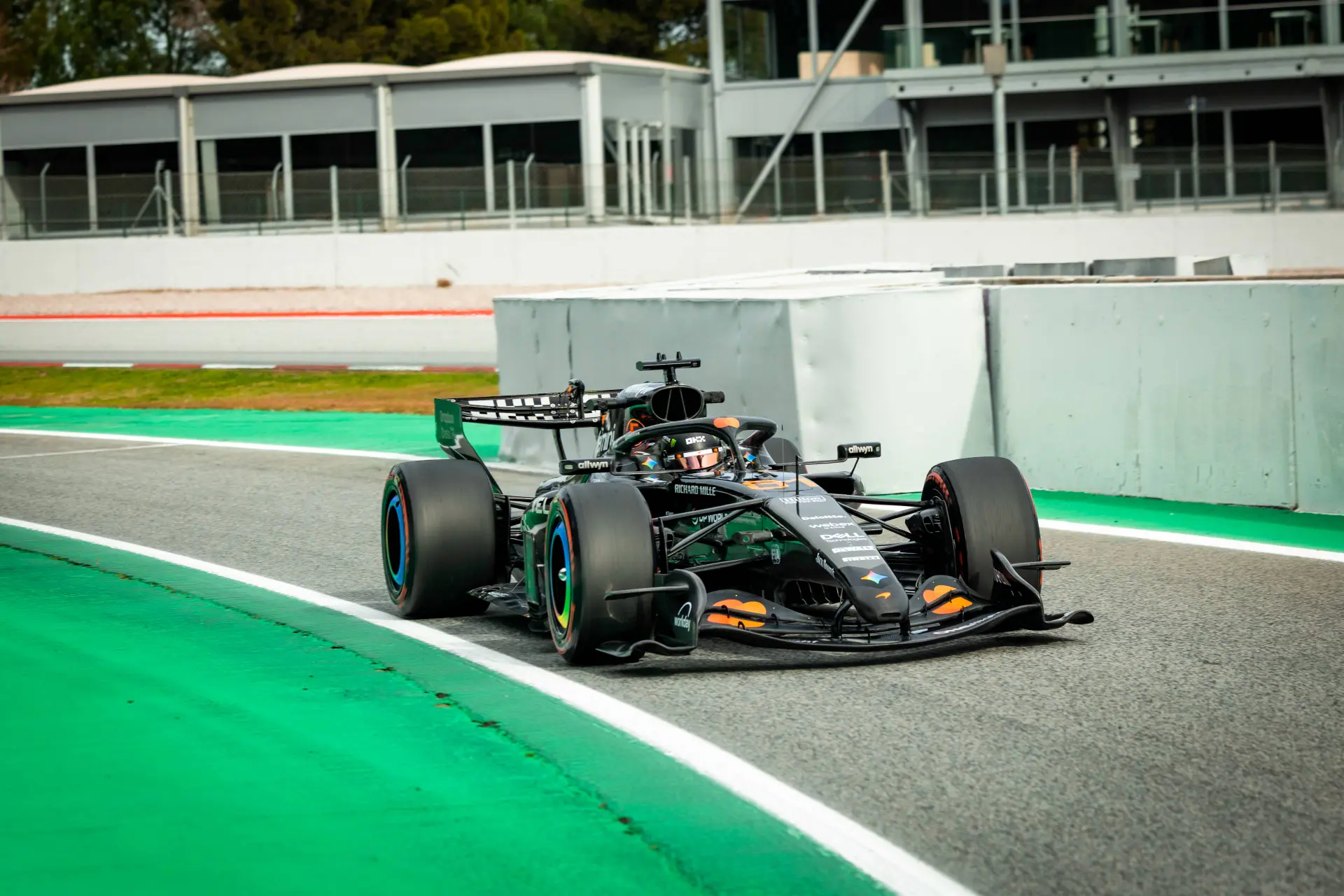
Push-rod front suspension with no anti-dive
ADVERTISEMENT
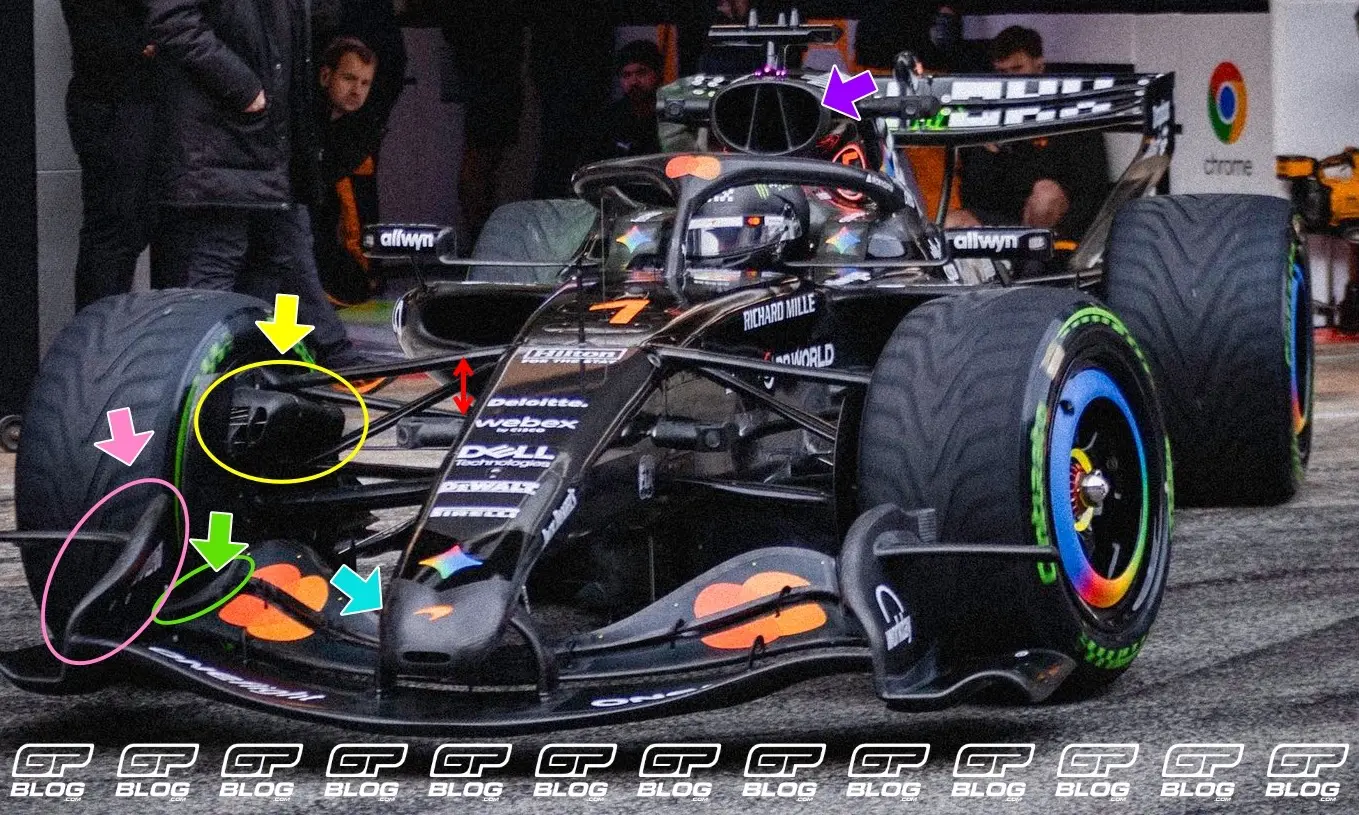
Starting with the front view, two details immediately catch the eye: the nose and the endplate design. The new RB22 still shows a very simplistic design of the front wing flaps and mainplane, and also the nose is quite different from the solutions adopted by other top teams.
The nose is large and thick along its entire length, and the two pylons that connect it to the mainplane are curved and have quite a simple shape (red circle and arrow), compared, for example, to the solutions adopted by Ferrari or McLaren.
As for the endplate of the front wing, it’s quite flat and straight, not as wavy as the MCL40’s one, but it has a very similar design to the lower tray.
About half the length of the tray has a shell shape, which is useful for pushing a good amount of air into this channel, generating a series of vortices and moving them outwards from the front wheels.
Looking at the front suspension scheme, a lot of interesting details emerge: first of all, Red Bull aligned with all other top teams and decided to adopt a push-rod front suspension scheme.
ADVERTISEMENT
The front and rear arms of the upper triangle, however, show very little height displacement, proving that Red Bull Racing’s engineers didn’t see the anti-dive angle as a useful solution to adopt on this new generation of cars.
The fairing of the front wishbone of the upper triangle has been carefully shaped, very similar to what McLaren did on the MCL39.
The goal is to channel air outwards through the front wishbone. This also helps direct hot air exiting the brake duct and the turbulence from the front tyres.
The pink circle and arrow, however, show the lower triangle, which has been positioned very low, not so much for mechanical reasons as for aerodynamic ones: in this way, the two arms channel air towards the floor inlet.
ADVERTISEMENT
With the same goal, the engineers positioned the steering rack midway between the upper and lower triangles (green circle and arrow), almost aligned with the floor support positioned behind and in front of the car's bodywork.
Last but not least, this view allows us to also appreciate the size of the air scope: as shown by the purple arrow, it has an oval shape, but is way smaller than the VCCARB’s one, despite the same engine.
Read also

Small sidepods and a huge 'hole' in the diffuser
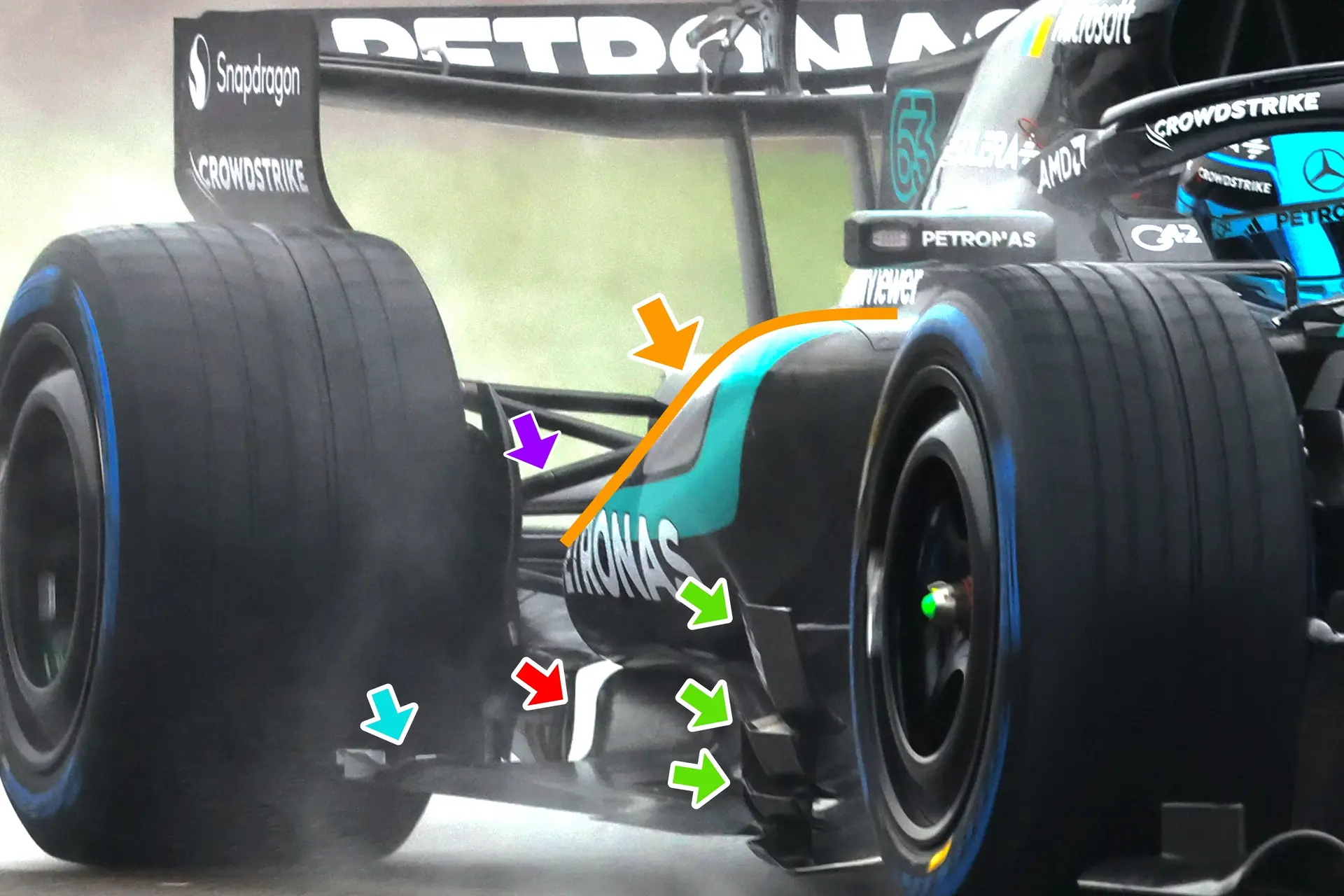
Moving now on to analyse the lateral view, a lot of differences with other top teams are visible: starting from the lower portion, the floor fence and circle has a very similar design to the one spotted on the Mercedes W17.
ADVERTISEMENT
The element is, in fact, divided in three horizontal sections, and every winglet has a frontal portion that is directed towards the outside and a rear portion that is directed towards the side pods.
The goal of this design is to have the front tire wake pass through the slots, preventing it from being directed towards the floor and bodywork.
Moreover, the engineers adopted a very similar solution to other top teams in front of the rear tyres: as highlighted by the light blue arrow and circle, the rear part of the floor shows three 45° cuts to help manage the tyre squirt, a solution largely adopted until the end of 2020, when cars still had very similar flat floors.
The differences between the RB22 and other cars, however, lie in the diffuser and sidepod design: starting from the diffuser, Red Bull Racing engineers decided to completely remove the diffuser's sidewalls, leaving instead a huge "hole" into which most of the air is channeled.
Ferrari and Mercedes, on the other hand, adopted much less extreme solutions, leaving the two sidewalls intact but placing rather conspicuous holes to channel more air towards the diffuser.
ADVERTISEMENT
As for the sidepods, the lateral anti-impact structure was placed high up and covered with a layer of carbon, becoming a true flow diverter (pink circle and arrow).
This solution, very similar to the one adopted by Mercedes on the W13 in early 2022, has the primary objective of channeling air towards the upper surface of the sidepods and, above all, generating a series of vortices at the ends that help keep the flow attached to the sidewalls, where otherwise the air flow would detach.
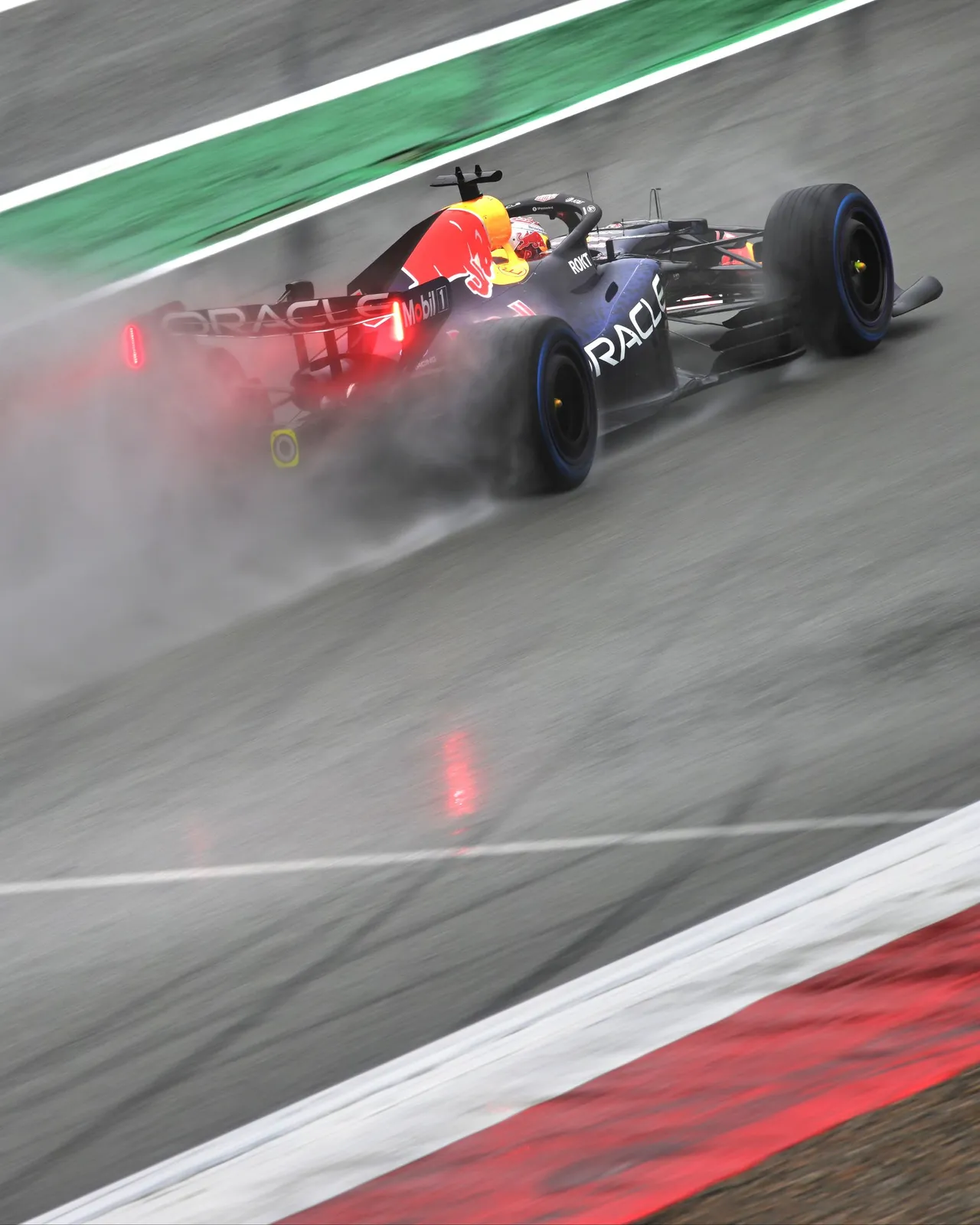
Max Verstappen driving in the wet at Barcelona - Image: Red Bull Content Pool
In this regard, the sidepods are very small and short, straight, and have a slight channel at the top to promote the Coanda effect. As the green arrows show, the goal of this design is to direct as much air as possible toward the bottom of the pod and toward the diffuser to generate downforce.
Last but not least, this lateral picture also shows the rear suspension, which has a push-rod suspension scheme, similar to what all other teams have done. Quite interestingly, however, the push rod is almost flat (yellow arrow), very similarly to what Mercedes did last year, to favour aerodynamics.
ADVERTISEMENT
In conclusion, the new RB22 features many innovative solutions, proof that the engineers preferred to follow their development path and verify their ideas on track before copying other top teams’ solutions.
Up until now, neither of the two drivers has set an impressive lap time but, since it’s only the third day of testing, the team will probably show a little bit more of their effective performance only during the two other testing sessions in Bahrain, which will take place between the 11th and the 13th of February and between the 18th and 20th of the same month.
Read also
Don’t miss GPblog in Google
Mark us as a preferred source and our articles will appear more often at the top of Top Stories.
Add as a preferred / source on GoogleRead more about:
latest news


Azerbaijan Grand Prix
Overview
Thursday 24.09.26
Practice 1
08:30 AM
Practice 2
12:00 PM
Friday 25.09.26
Practice 3
08:30 AM
Qualification
12:00 PM
Saturday 26.09.26
Race
11:00 AM
Thursday 24.09.26
Practice 1
Thu 08:30 AM
Practice 2
Thu 12:00 PM
Friday 25.09.26
Practice 3
Fri 08:30 AM
Qualification
Fri 12:00 PM
Saturday 26.09.26
Race
Sat 11:00 AM
Times are in your local timezone
Popular on GPBlog

1
Hamilton breaks silence on Ferrari staff shake-up rumors
950 times read

2
Red Bull set to confirm Hadjar and Lawson 2027 decisions within days as Tsolov complicates the equation
771 times read
3
McLaren makes decision on Norris' participation in the 24 Hours of Le Mans
562 times read
4
Ralf Schumacher reveals Vasseur was 'annoyed' with both Hamilton and Leclerc at Madrid
545 times read
F1-stand 2026
Season
| Pos. | Driver | Team | Points |
|---|---|---|---|
1 | MercedesMER | 292 | |
2 | MercedesMER | 211 | |
3 | FerrariFER | 191 | |
4 | McLarenMCL | 186 | |
5 | FerrariFER | 167 | |
6 | Red Bull RacingRBR | 145 | |
7 | McLarenMCL | 120 | |
8 | Red Bull RacingRBR | 71 | |
9 | Racing BullsRCB | 59 | |
10 | AlpineALP | 41 |
Loading