
Shanna is a Formula 1 journalist at GPblog, specializing in both F1 and endurance and GT racing. With a Master’s degree in Journalism and experience at international circuits, she provides in-depth, reliable coverage and insights based on her presence at Grands Prix and racing events worldwide.
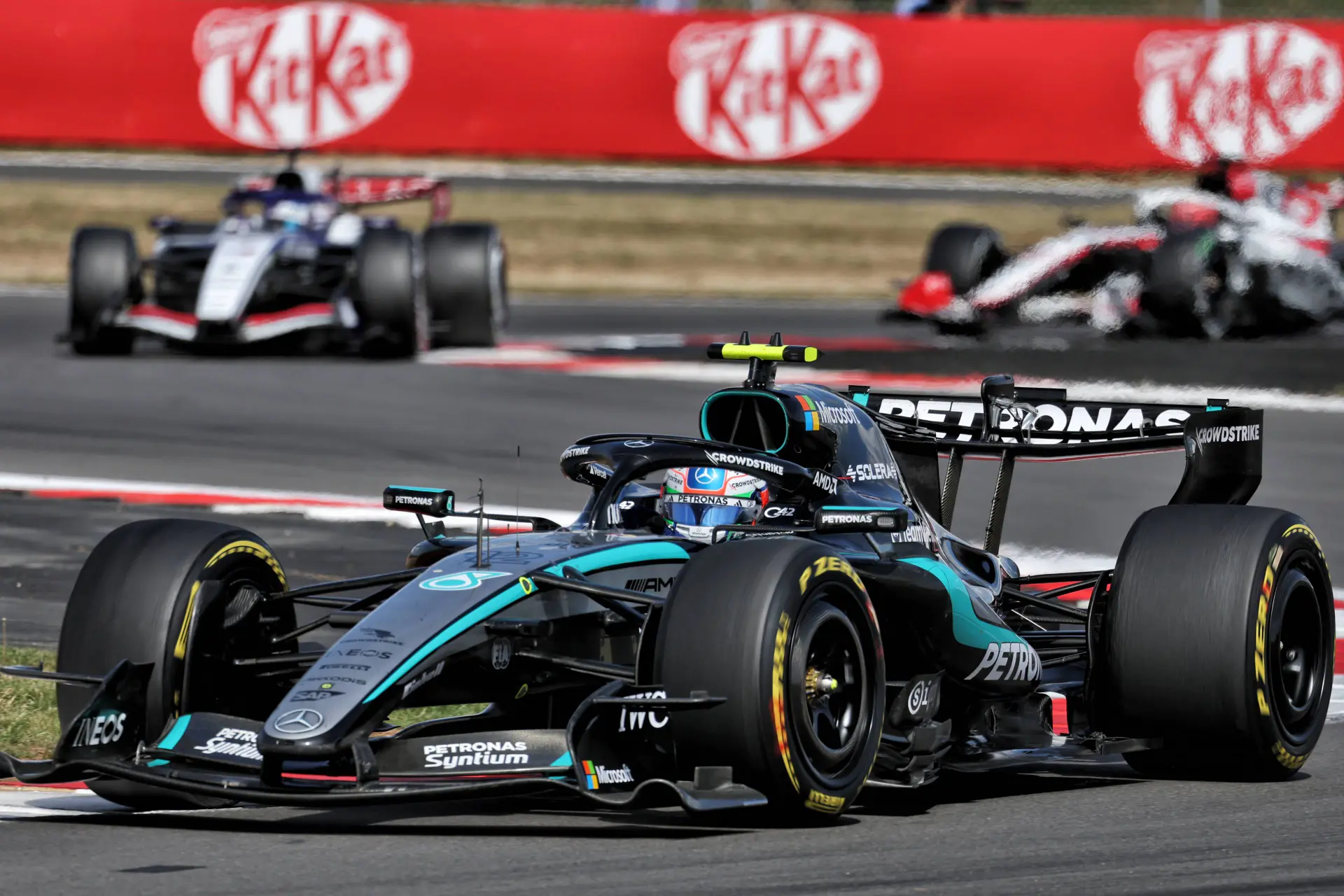
During the British Grand Prix, Mercedes drew attention with a striking qualifying trick, where George Russell and Kimi Antonelli briefly lifted off the throttle to actually go faster. The clever, legal interpretation of the regulations will undoubtedly get Red Bull Racing, Ferrari, and McLaren thinking. Still, the tactic is also not without risk.
During the race weekend at Silverstone, it became apparent that the Mercedes drivers had found a certain trick that allowed them to gain an advantage while remaining within the rules.
The approach is very similar to a trick the German outfit used earlier this season. At the time, similarly to Red Bull, Mercedes managed to achieve a cliff-edge ramp-down rate instead of a gradual one by switching off the MGU-K. As a result, the cars could use the maximum power of 350 kW for longer, which yielded an advantage of 50 to 100 kW just before the finish.
After the Japanese Grand Prix, however, the FIA put an end to that practice. Because the MGU-K remained inactive for sixty seconds after being switched off, cars would sometimes run too slowly on track or even come to a halt. For safety reasons, the FIA ruled that the MGU-K may only be switched off in genuine emergency situations.
It now appears that Mercedes has found a legal way to use the trick after all, providing a speed advantage, although a mistake in its execution carries a risk.
ADVERTISEMENT
Mercedes lifts off before start-finish
GPblog, following a report by The Race on this trick, analysed the telemetry data to find out exactly what it entails. It boils down to Mercedes gaining speed by briefly easing off the throttle before crossing the start-finish line. By momentarily lifting, both drivers could access maximum electrical power again on the straight towards Turn 1.
Since this “trick” is currently legal, we can expect multiple teams to adopt it in the coming races.

The telemetry data from sprint qualifying at the 2026 British Grand Prix - Source: GPTempo/Illustration: GPblog
The graph above shows that George Russell’s and Kimi Antonelli’s speeds were higher than Lewis Hamilton’s at the beginning of the lap, and at the end, right before the line, Hamilton is quicker again.
ADVERTISEMENT
At that point, the difference is around nine to 13 kilometres per hour compared with the Ferrari driver, and it is clear that both Mercedes drivers lift off the throttle. On the circuit map, there is also a small red section where Hamilton is faster, right in “Mercedes territory.”

Throttle percentage telemetry during Mercedes’ “trick” - Source: GPTempo/Illustration: GPblog
It becomes even clearer when we zoom in on the throttle telemetry. Antonelli, the light blue line, lifts earlier than Hamilton and shows a throttle percentage of just forty percent, while Hamilton is at 94 percent. There, the seven-time world champion hits a top speed of 271 kilometers per hour, while Russell and Antonelli are both under 260 kilometers per hour.
The risks of the new trick
What Antonelli and Russell did during sprint qualifying must be executed with precision. While it is relatively easy for teams to program the power unit to deliver the maximum 350 kW for as long as possible, it is much harder to get the driver to lift at exactly the right moment. That’s where a driver runs the greatest risk of getting it wrong: he must lift just before the battery is completely drained.
ADVERTISEMENT
If he’s too late and the battery reaches zero percent, the MGU-K switches off. That would violate the aforementioned ramp-down rate rules and the car would no longer comply with the FIA technical regulations. To prevent that, drivers must know exactly how much energy remains in the battery. That percentage also varies from lap to lap.
The Race indicates that Mercedes developed a system in which the drivers were warned by audio cues as soon as the battery reached a predetermined level above 0%. At that moment, they had to lift off the throttle immediately. It’s likely that this “trick” was practised in the simulator and that the correlation was optimal as a result.

Don’t miss GPblog in Google
Mark us as a preferred source and our articles will appear more often at the top of Top Stories.
Add as a preferred / source on Google