Van Hoepen proves he has learned from ‘regret’ with impressive start to F2 season
Tim Kraaij is Editor-in-Chief of GPblog.com and a Formula 1 analyst. With permanent FIA accreditation and direct access to the paddock, he delivers in-depth, data-driven analysis and insight into key developments within the sport.
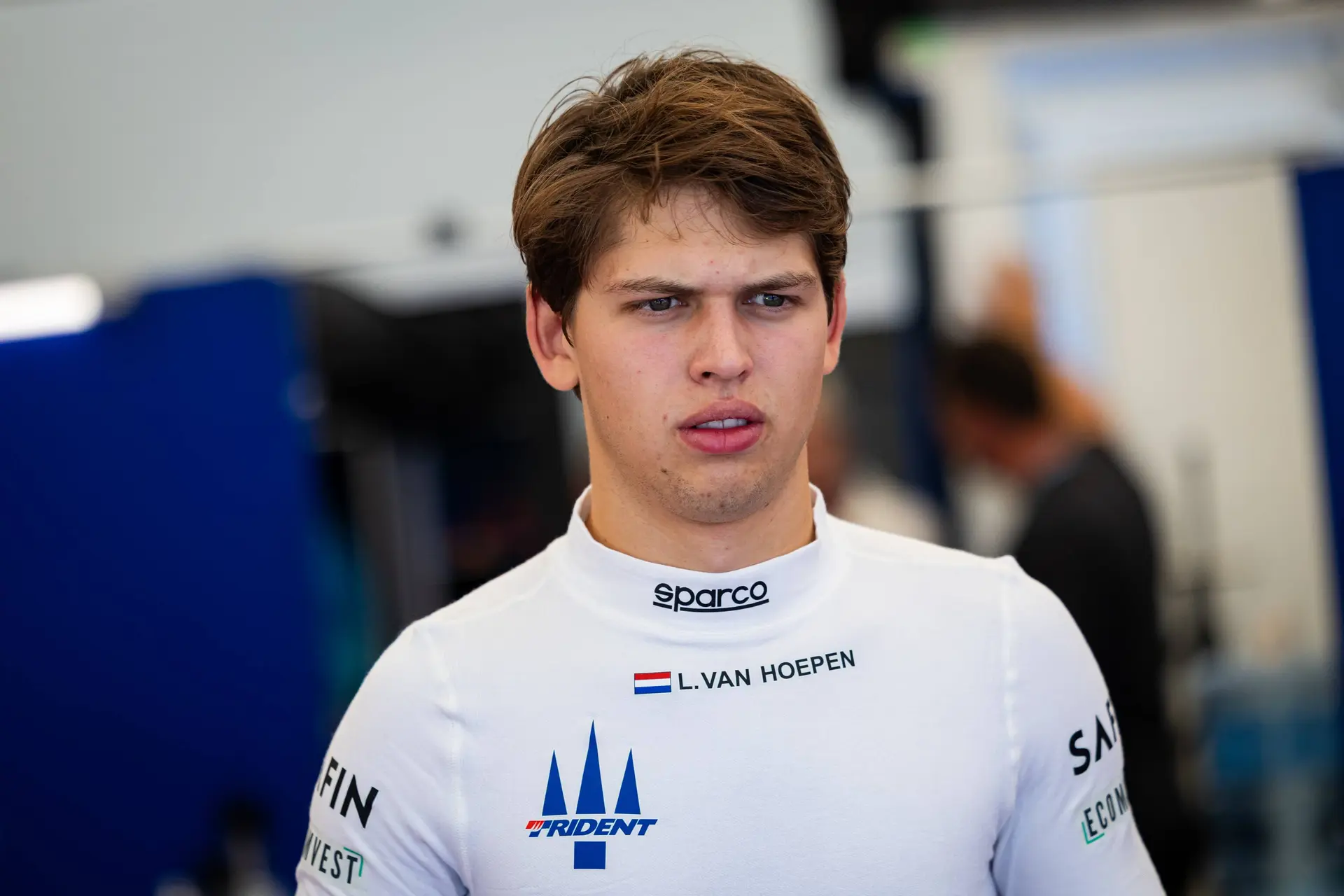
Laurens van Hoepen regrets his choice to stay with ART in Formula 3 for another year. Still, the Dutchman learned a lot from that season and can now put it into practice at Trident, where he has made an excellent start to the new Formula 2 season.
After a strong debut year in Formula 3, Laurens van Hoepen opted for another year in the same class. The goal was clear: fight for the title. However, things turned out differently for the driver born in Wassenaar. ART didn’t have things sorted under the new regulations, and Van Hoepen found himself not at the front, but at the back in Formula 3.
After a season of hard work in F3, the 20-year-old has now made the step up to Formula 2 and is also driving for a new team. Trident picked up Van Hoepen, and in Australia the new combination proved immediately successful. The Dutchman drove from P11 to P3, scoring his first podium in the category right away.
During the break caused by the cancellation of the Bahrain and Saudi Arabian Grands Prix, Van Hoepen sat down for an exclusive interview with GPblog. He spoke in detail about his move to Trident, the regret he feels about his second season with ART, and everything he still learned from that tougher year.
First of all, I’m curious about the start of your Formula 2 season, because with a podium you’ve begun nicely.
ADVERTISEMENT
“Yes, exactly. A really good start. Testing already went quite well in Barcelona. We were consistently in a pretty good spot there. In Australia we were also in good shape, only the free practice was a shock. That didn’t go entirely to plan, but we immediately knew what the issue was.”
“In qualifying I had a bit of bad luck at the start of my lap because of the red flag. That hindered everyone, but then we only had one lap at the end. There was so much traffic that I basically had to get on the throttle just as my lap began. The tires were nowhere near the right window to start the lap. The first sector was terrible, and after that we were in good shape. We just missed out on the top ten, which was a shame.”
“In the sprint race and the feature race we were then very fast. The sprint was okay with P7. The feature race was just a very well-driven race to P3, with a good pit stop and a point for the fastest lap as well. So that was a good start in that sense.”
You switched from ART to Trident. How has that step worked out for you?
“Good. I’m very happy within the team. I’m very happy with my race engineer, and basically everyone around me is just good and hugely motivated to do much better this season than last year. That was also one of the reasons for me to go to Trident. Everyone there is just hugely motivated and working really hard to do as well as possible.”
ADVERTISEMENT
Before making this move you also spoke with Richard Verschoor. He hasn’t always been full of praise for Trident. Did you ever doubt this step because of that?
“Yes, of course. It’s a very tough choice. But especially with the season I had (in 2025, ed.), we didn’t really have a lot of options to go to many teams anyway. With some teams there were also things going on in the background that influenced my decision. And some teams weren’t as motivated as Trident. We really saw the potential there. I think we still have quite a few steps to make, but so far it’s going okay.”
At the end of 2025 you already drove in Formula 2 for Trident. To what extent did that help you at the start of this season?
“A lot. We really used that last event to test things for this year. So we got a lot out of that already. For myself it also helped to have done a couple of pit stops and to know how the start procedure works in Formula 2. There are quite a few aspects that are different in Formula 2 compared to Formula 3. Then it helps to have already done a few races before the real season starts.”
Do you have an example of things you’re carrying into this season?
ADVERTISEMENT
“A lot of things we tested on the car, which we then got a lot out of over the winter. The team worked incredibly hard in the winter to analyze all that data properly and really take a step with it. And of course there are things you can work on in the sim as well. For example, how to warm up the tires—that’s a very important point, especially in F2. If that doesn’t go well, you might as well go home. Those are things you learn from and that you can work on in the sim. Because what if it’s five degrees colder one week and there’s traffic—how do you handle the tires and your brakes then? It’s not just the tires, but also the brakes. In F2 they’re carbon. You need to have them up to temperature at the start of the lap, otherwise you get to Turn 1 and you don’t brake. That’s a hugely important aspect. So it’s nice to already have that experience and the feel for how to do it.”
So a lot comes down to the driver in Formula 2?
“Of course the team helps, but in Formula 2 as a driver you can make just a bit more of a difference. It’s still very important how the car is set up. Unfortunately, that’s still an important factor.”
If you look back at last year. You did an extra year in Formula 3 with ART. Do you regret not moving up to F2 a year earlier?
“I think it was good for me to do another year in Formula 3, just not with ART in hindsight. That’s basically what it comes down to. We had mega good offers from other teams we could have driven for. However, we stayed loyal to ART and thought, we have the same team around us, it should work out and we’ll fight for the title. Unfortunately, that didn’t turn out to be the case. That’s a real shame. It’s of course easier to say in hindsight. You’re still active in Formula 3 for another year, but not in the place you’d want to be.”
Text continues below the image.

Laurens van Hoepen had “mega offers” to leave ART - Photo: RacePictures
ADVERTISEMENT
What lessons do you take away from a season like that?
“You can always keep learning and you always have to keep making steps. What I mainly worked on last year, and what really helped me, is the mental aspect of suddenly not being competitive and still keeping at it and never giving up. Going there every day and working to make it a bit better that weekend. It’s obviously tough when things aren’t going well. You go into the season thinking you’ll be fighting for the title and then you’re eighteenth in qualifying. It’s really hard not to get demotivated, but we actually did that pretty well. We gave it our all constantly.”
Most people see Formula 2 and Formula 3 as spec series, where it comes down to the driver because all the cars are the same. Can you explain why there are still such big differences between teams in those series?
“Because they’re still very specific cars and the window in which the car works is very narrow. So the setup is super, super important. If you don’t fully understand that, you can lose so much grip that you’re already 1-0 down.”
“That was the case at ART last year. We simply didn’t understand the setup philosophy. How we thought the car should be run was fundamentally wrong. Because of that, you never get as much grip as the other teams produce. I spoke to my engineer from last year in Melbourne and he said, ‘the car is completely different from last year. If you’d had this car, you would have been on pole.’ I said thank you, but that doesn’t help us now. Couldn’t you have done that last year? It’s just a shame.”
ADVERTISEMENT
Has that lesson—the importance of the team to be successful—also been important in choosing Trident now?
“That definitely had an effect. That’s also a thing. I knew Trident would be a different team than it was last year. New people have come to Trident. So that was certainly something we thought about and thought: ‘Something good could come out of that.’
“They’re very willing to go in a different direction. To really work hard and get it done now in Formula 2. Trident is of course a mega good team in Formula 3. That also contributed to the choice. If they understand it in Formula 3, then they can do it reasonably well in Formula 2 too.”
How different is Formula 2 compared to Formula 3?
“Actually, it’s not that bad. There are a few important things that are different. The brakes I just mentioned. They’re carbon instead of steel in Formula 3. That’s an important thing to get in the right window. You also definitely feel the extra power you have in F2 with the turbo that kicks in and is much stronger. In F3 you don’t have a turbo. Those are a few things that feel different, but beyond that, it’s still a formula car.”
Don’t miss GPblog in Google
Mark us as a preferred source and our articles will appear more often at the top of Top Stories.
Add as a preferred / source on Google