How Verstappen's Las Vegas qualifying lap could change under 2026 F1 rules
Updated:
0 Comments

Shanna is a Formula 1 journalist at GPblog, specializing in both F1 and endurance and GT racing. With a Master’s degree in Journalism and experience at international circuits, she provides in-depth, reliable coverage and insights based on her presence at Grands Prix and racing events worldwide.
Max Verstappen expects the deployment of electrical energy to play a major role at the Las Vegas Grand Prix. The long straights in particular will challenge the new generation of Formula 1 cars. GPblog's simulation shows where the Dutchman may have to go slower.
Verstappen returns this weekend to the circuit where he claimed victory last year from second on the grid. During qualifying in 2025, he set a lap time of 1:48.257 on a wet track. That is why his dry qualifying lap from 2024, when he clocked a 1:32.797, was chosen for comparison. With the new technical regulations, the performance of Formula 1 cars has changed considerably this season. The increased contribution of the battery in particular makes energy deployment over a lap more important.
Simulation of the potential fastest lap
To illustrate the potential effects in Las Vegas, GPblog compared the fastest qualifying laps from 2025 and 2026 at seventeen comparable circuits. In each case, the absolute fastest qualifying time was used, regardless of which driver set it. The wet qualifying session in Brazil and the circuits in Madrid and Malaysia, which are not directly comparable, were excluded.
The comparison shows that the fastest qualifying laps in 2026 are, on average, 2.82 percent slower than they were a year earlier. Applying that figure to Verstappen's dry lap in Las Vegas in 2024 gives a theoretical lap time of 1:35.417, a difference of 2.620 seconds. This calculation is only a prediction of Verstappen's actual qualifying time. The accompanying graph uses real telemetry from 2024 and shows how the new power units could affect speed across different parts of the circuit.
ADVERTISEMENT

A simulation of Max Verstappen's potential fastest lap during qualifying in Las Vegas - Source: GPblog
Long straights pose a challenge for the drivers
The difference in energy management could play a key role on the Las Vegas Circuit in particular, where drivers stay at high speed for an extended period after Turn 12. The graph shows that speed levels off earlier on this straight than it did on the 2024 reference lap. As is well known, the new engines have significantly more electric power, but the available energy has to be distributed over the lap. When the electric boost drops off, acceleration can also suffer. On a circuit with such long straights, that can cost a considerable amount of time.
This was also one of the areas Verstappen focused on during his preparations. After finishing second in Brazil, he returned to the Red Bull Racing factory in Milton Keynes to work in the simulator. "It is such a different track, it is a fast circuit and has the long straight, so the energy deployment and management will be a factor," the Dutchman said in his preview of the race weekend.
Deploying electric power aggressively on the exit of Turn 12 initially saves time, but can leave less boost available later on the straight. This difference could be particularly noticeable on The Strip, where drivers spend a long time at full throttle.
ADVERTISEMENT
The final part of the lap also calls for smart energy deployment
A similar picture emerges on the straight after Turn 16, leading to the start-finish line. The graph shows a lower top speed there than in 2024. How much electric boost is still available at that point could determine the speed at which Verstappen completes his lap. There is also a difference between Turns 4 and 5. Extra electric power could initially provide stronger acceleration there, while the boost may begin to fade sooner on the approach to the next braking zone.

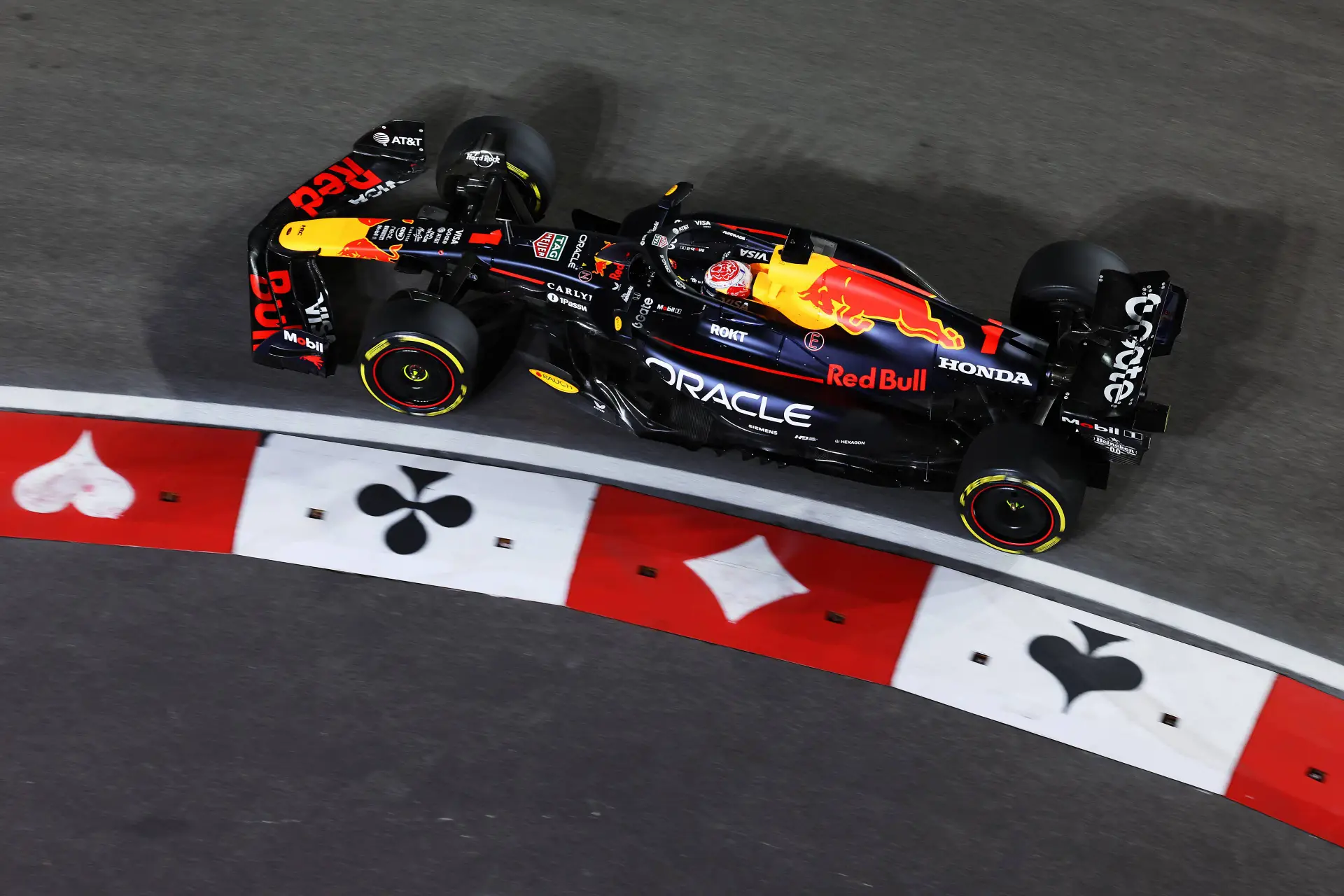
Las Vegas will be a challenge with the 2026 cars - Photo: Red Bull Content Pool
The two speed curves remain relatively close together through the slower corners. The biggest differences occur on the straights, where the combination of electric power, energy consumption and top speed plays an important role. The car's setup and the way Red Bull deploys the available energy will therefore be especially important. After the Sao Paulo Grand Prix, Verstappen also pointed to the potential benefit of a slipstream. By following another car down a long straight, a driver can benefit from reduced aerodynamic drag. In Las Vegas, that could help partially offset a top-speed deficit.
Low temperatures add further uncertainty
ADVERTISEMENT
In addition to energy management, Verstappen expects low temperatures to play an important role. "I have to say that it's normally not our best track because of that, but we'll see if we can get the tyres to work. That's the key, to be honest, around there," he warned.
Differences in grip and tyre temperature could have a significant impact on the course of a lap, particularly in braking zones and slow corners. This makes it important for teams to get the tyres into the right temperature window quickly, while also taking the deployment of electric power into account.
Red Bull's challenge, then, is not simply to find as much top speed as possible. Managing electric power over the long straights will be just as important. Verstappen has already prepared for that challenge in the simulator, but the practice sessions will show which approach works best on the street circuit.
Read also
ADVERTISEMENT
Don’t miss GPblog in Google
Mark us as a preferred source and our articles will appear more often at the top of Top Stories.
Add as a preferred / source on Google