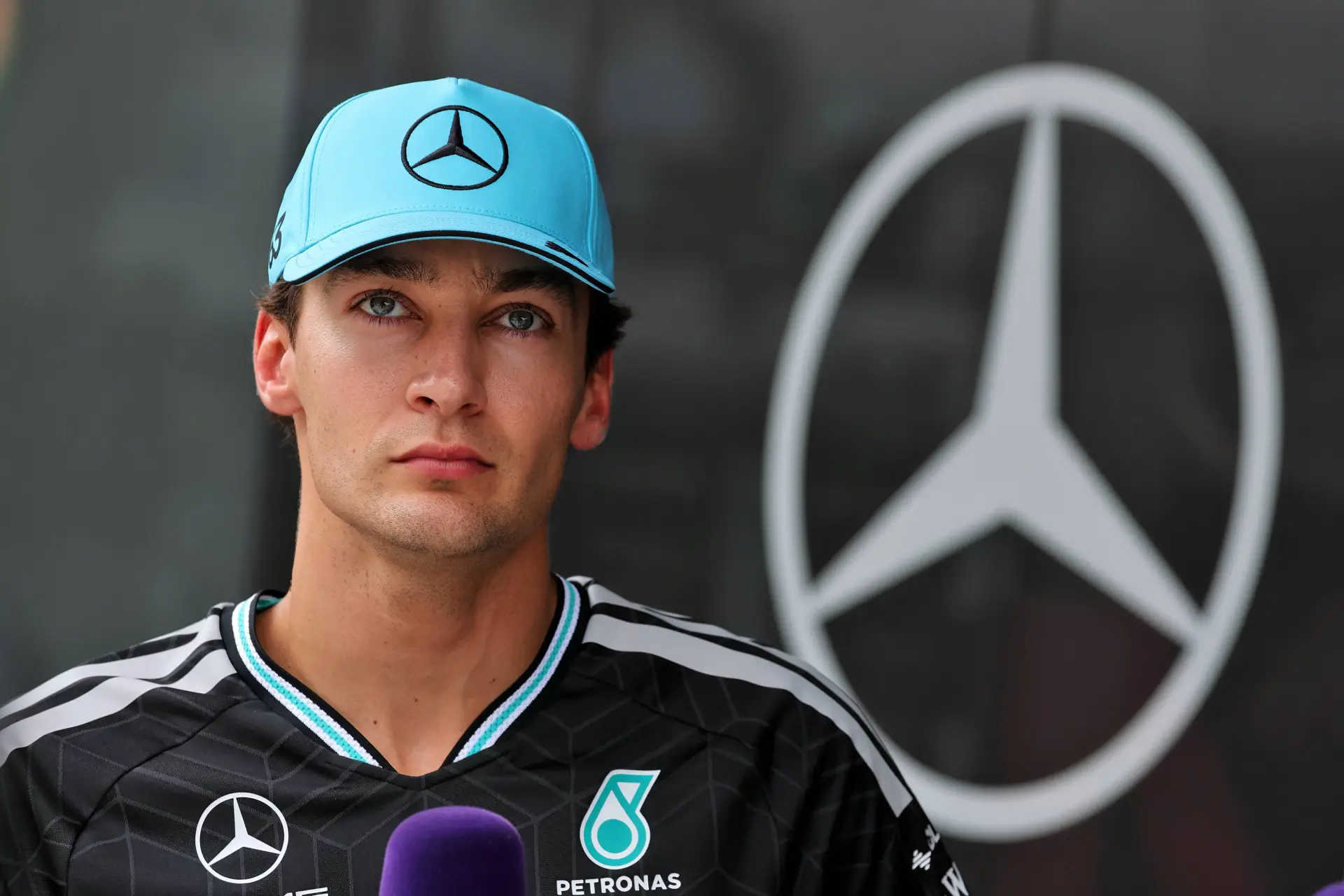
Red Bull's Las Vegas challenge: Finding the right balance for Verstappen and Hadjar

Shanna is a Formula 1 journalist at GPblog, specializing in both F1 and endurance and GT racing. With a Master’s degree in Journalism and experience at international circuits, she provides in-depth, reliable coverage and insights based on her presence at Grands Prix and racing events worldwide.
Max Verstappen had a difficult Friday in Las Vegas. Rain meant the Dutchman could barely complete any representative laps, and he was also unhappy with the balance of his Red Bull. What do the limited lap times tell us about the competitive order, and what challenges await Verstappen in qualifying and the race?
George Russell ended FP2 fastest, with Pierre Gasly and Charles Leclerc behind him. Isack Hadjar finished in P4, while Verstappen was almost three seconds off Russell's pace. The gap between the Red Bull Racing drivers was 1.734 seconds, but their programmes were hardly comparable. Verstappen completed just two representative lap times. He spent most of his other laps running at a much slower pace, while the track continued to dry throughout the session.
"The conditions weren’t really representative with the weekend looking dry, so there wasn’t much value in running today," Verstappen explained afterwards. "We only did a couple of laps to see where the car was at and identify a few areas to focus on tomorrow, but overall it was a pretty unproductive day because of the weather. With only one practice session left before Qualifying, it’s important that we have a good one and optimize everything we can."
All of Verstappen's lap times in FP2
During FP2, both Verstappen and Hadjar complained about the power delivery. According to technical director Pierre Waché, this was mainly related to energy management and the deployment of the MGU-K. The lack of grip made it difficult to distribute the electrical energy optimally over a lap. After FP1 produced no representative times, FP2 also proved far from useful. Verstappen's lap times show that the data is impossible to make sense of, so the long runs have been pushed back to Saturday.
ADVERTISEMENT
| Lap | Lap time |
| 1 P | 20:09:19 |
| 2 P | 7:13.496 |
| 3 P | 6:35.944 |
| 4 | 33:16.256 |
| 5 | 1:50.981 |
| 6 | 1:50.141 |
| 7 | 2:35.844 |
| 8 | 2:40.927 |
| 9 P | 2:34.801 |
The limited grip meant it took Red Bull time to optimise the electric power delivery. Verstappen's dissatisfaction, however, went beyond that. "It was about the balance of the car, not the power, and he (Verstappen) wasn't happy with the way the car was behaving," Waché clarified, adding that Red Bull was still investigating the source of the problem.
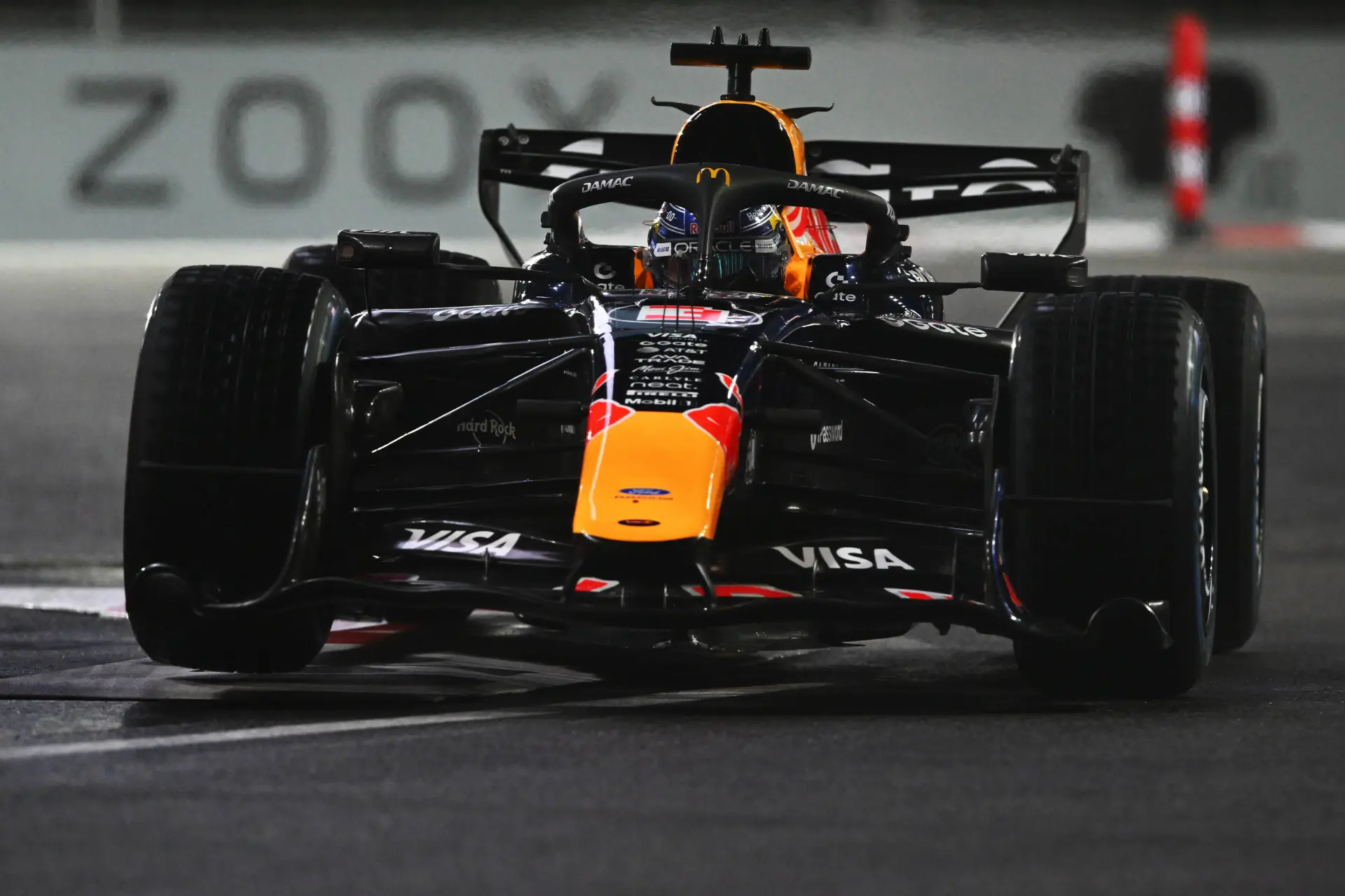
Red Bull has brought a revised front wing to Las Vegas. The change is a small aerodynamic element on the endplate, known as a dive plane, which has been lowered and shortened. The team hopes this will stabilise airflow around the front wing and further back. The update was originally scheduled to be tested in FP1, but the rain made that impossible. Waché said conditions in FP2 were also unsuitable for properly evaluating the modification. Red Bull therefore hopes to carry out the test in FP3. Hadjar does not expect the small change to deliver a gain of a tenth of a second or more.
Teams left in the dark
The other teams also had to contend with changing conditions. Norris was relatively quick earlier in FP2, while Russell and Leclerc improved towards the end of the session. That contrast is reflected in the selection of lap times below from Mercedes, Ferrari and McLaren. Needless to say, these numbers reveal nothing about the pecking order for the weekend either. They are included only to show what the teams were doing towards the end of the second practice session.
ADVERTISEMENT
| Lap | RUS | HAM | LEC | NOR | PIA |
| 1 | 1:54.365 | 1:52.891 | 1:54.792 | 1:54.615 | 1:56.011 |
| 2 | 1:53.997 | 1:58.126 | 1:52.428 | 1:52.432 | 1:54.173 |
| 3 | 1:52.730 | 1:55.886 | 1:51.482 | 1:55.619 | 1:52.431 |
| 4 | x | 1:59.901 | 1:54.226 | 1:50.930 | 1:53.909 |
| 5 | x | 1:51.545 | 1:57.963 | x | 1:51.482 |
| 6 | 1:49.968 | x | 1:54.688 | 1:48.837 | |
| 7 | x | 1:49.262 | 1:49.166 | 1:51.360 | |
| 8 | 1:51.886 | 1:58.846 | 1:56.316 | 1:49.354 | |
| 9 | 1:49.189 | 1:55.019 | 1:48.473 | ||
| 10 | 1:58.129 | ||||
| 11 | 1:47.605 | ||||
| Average | 1:52.023 | 1:55.185 | 1:53.206 | 1:51.878 | 1:53.601 |
Norris comes out on top with an average of 1:51.878, narrowly ahead of Russell. However, no conclusions can be drawn from this about their pace over longer stints. The drivers were on track at different times, and grip levels were constantly changing. Oscar Piastri said after the session that the intermediates were initially even more difficult to use than the full wets. Conditions only improved once a drier line began to form.
This confirmed how dramatically conditions changed throughout FP2, according to the McLaren driver. This has major implications for race preparation. Under normal circumstances, the second practice session is used to assess tyre wear over longer stints. Now, teams will have to rely largely on simulations and the limited data they can still gather during FP3.
Set-up plays a major role in warming up the tyres
For qualifying, tyre temperature will be a particular challenge. Russell pointed out that the active aerodynamics on the new Formula 1 cars cause the tyres to cool more on the long straights. In Straight Mode, the cars run with less downforce, which puts less load on the tyres. That makes it harder to maintain sufficient grip in the low temperatures in Las Vegas. For teams that have brought circuit-specific aerodynamic components, such as Red Bull with its front wing, this could pose an additional challenge.
ADVERTISEMENT
"They are working on a setup to try to put as much energy as possible on the front axle," Pirelli engineer Simone Berra said in response to a question from GPblog. "They said that you generate more temperature on the on the tyres, especially on the front, working more on the suspension, in my opinion, than on the ride height itself. For sure, the downforce, it's a it's a significant factor. We will see a lot of weaving tomorrow preparing the lap."
Tyre pressures can also help. According to Pirelli, a higher starting pressure creates a smaller contact patch with the asphalt, generating more heat on the tyre surface. This gives teams another way to influence the warm-up process.
The setup could therefore play an important role for Red Bull. Verstappen still needs to find a solution to his balance problems, while the team must also take tyre temperatures into account. More downforce can help generate heat, but on a circuit with such long straights, it could come at the cost of top speed.
Read also
ADVERTISEMENT
Don’t miss GPblog in Google
Mark us as a preferred source and our articles will appear more often at the top of Top Stories.
Add as a preferred / source on Google